

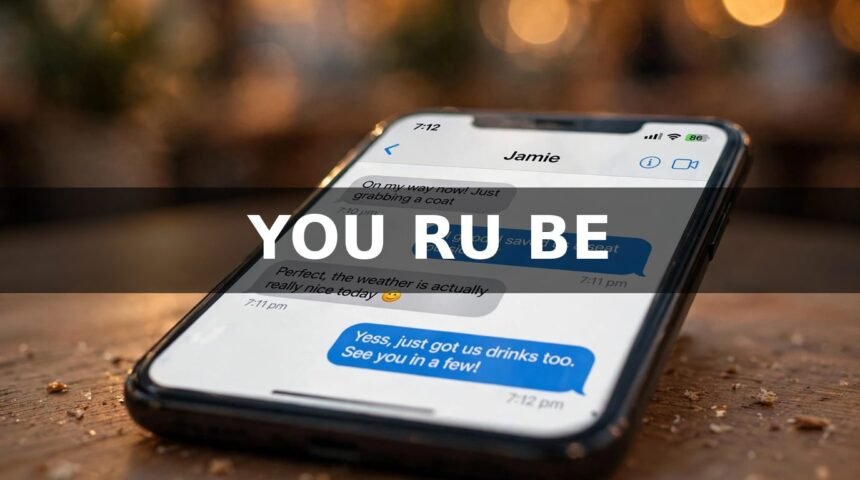
If you typed “you ru be” into a search box, you probably already suspect something: it does not look quite right, but it also does not look completely random. You are right on both counts. “You ru be” is not a standard English phrase, and you will not find it in a dictionary. But it is not meaningless either. It is the kind of string people end up searching when they have seen or heard something close to it and want to know what it actually means.
The short answer is that “you ru be” almost always points to one of three things: the texting shorthand “R U” (short for “are you”), the dialect phrase “you be”, or a mix-up with the word “rube”. Which one applies depends entirely on where you saw it and what was around it. This article walks through all three, with examples, so you can work out which meaning fits your situation — and search for the right thing next time.
What Does “You Ru Be” Mean?
There is no single answer, and that is the honest truth. “You ru be” is not an idiom, a slogan, a song title, or a recognised expression in standard English. If someone told you it has one fixed meaning, they were guessing.
What it almost certainly is, though, is a garbled version of something else. People arrive at this exact string of words in a few common ways: they mishear a phrase in a song or a video, they read a text message written in heavy shorthand, they type a phrase into a search engine the way it sounded rather than the way it is spelled, or autocorrect and voice-to-text turn a normal sentence into something strange. Once you know the three usual suspects, the mystery mostly disappears.
Here is the quick version:
- “R U” — texting shorthand for “are you”, as in “you r u ok?” which is really “are you okay?”
- “You be” — a phrase from African American Vernacular English (AAVE) and some other dialects, used to describe something habitual, as in “you be working late” (you are usually working late).
- “Rube” — a real English word, pronounced “roob”, meaning an unsophisticated person from the countryside. People sometimes type “you ru be” when they heard “you rube” and split the word in the wrong place.
The rest of this article takes each one in turn, explains how it is used, gives real examples, and shows you how to tell which one you are dealing with.
Meaning 1: “R U” — Texting Shorthand for “Are You”
This is the most likely explanation in most cases, especially if you saw “you ru be” in a text message, a chat, a comment, or a social media post. “R U” is one of the oldest pieces of texting shorthand there is. It has been around since the days when mobile phones had number keys and every character cost effort — and it never really went away.
How “R U” works
In texting shorthand, single letters and numbers stand in for whole words that sound the same. “R” sounds like “are”. “U” sounds like “you”. Put them together and “R U” means “are you”. It is the same logic behind “CU” (see you), “B4” (before), “GR8” (great), and “2moro” (tomorrow).
So when someone writes something like:
- “R U coming tonight?”
- “R U ok?”
- “R U sure about that?”
- “What R U doing?”
they are simply asking “Are you coming tonight?”, “Are you okay?”, “Are you sure about that?” and “What are you doing?” — just faster, and with fewer keystrokes.
Where “you ru be” comes from here
Now imagine a sentence like “you R U be” or “R U be going?” typed quickly on a phone, or a voice-to-text tool trying to transcribe it. The letters get rearranged, the spacing shifts, and what lands on the screen is “you ru be”. It is also possible someone typed “you r u b” — meaning “you are you be…” — and the pieces merged in an odd way.
Another common route: someone hears “are you” spoken quickly in a video or a song — “r yuh” — and tries to spell it phonetically. “Ru” is a natural guess for how “are you” sounds when it is slurred together. Add “be” from the next word, and you get “you ru be”.
Examples of “R U” in everyday messages
Here is what this shorthand looks like in real conversations:
- “Hey, R U free on Saturday?” — Are you free on Saturday?
- “R U at home yet?” — Are you at home yet?
- “R U gonna watch the game?” — Are you going to watch the game?
- “R U serious right now?” — Are you serious right now?
If the message you saw looks anything like these — a question, casual tone, probably on a phone — then “R U” is almost certainly what you are looking at. The “be” that follows is usually the start of the next word or a stray fragment, not part of the shorthand itself.
Is “R U” still used today?
Yes, though less than it used to be. Full keyboards, predictive text, and voice messages have made shorthand less necessary than it was in the era of old keypad phones. But “R U” survives in casual chats, gaming messages, comments, and anywhere people type fast and informally. It also shows up in usernames, memes, and song lyrics, where the playful spelling is part of the point.
There is no rule that says you must use it. Plenty of people write “are you” in full even in the most casual chat. “R U” is simply a style choice — quick, informal, and understood by almost everyone who texts.
Meaning 2: “You Be” — A Dialect Phrase
The second possibility is that “you ru be” is a mishearing or mistyping of “you be”, a phrase that is perfectly normal in some varieties of English, even though it looks wrong in standard English.
What “you be” means
In African American Vernacular English (AAVE), and in some Southern and Caribbean-influenced varieties of English, “be” is used in a special way. It marks something habitual — something that happens regularly or over a long period. Linguists call this the “habitual be”.
In standard English, you would say:
- “You are always working late.” (habitual — it happens a lot)
- “You are working late.” (right now, this once)
In AAVE, the habitual version can be expressed as:
- “You be working late.”
That sentence does not mean “you are working late right now”. It means “you are usually working late” or “you are the kind of person who works late”. The “be” carries the meaning of “regularly” or “habitually”. It is a grammatical feature with a real job to do, not a mistake.
Examples of “you be” in context
Here are a few examples of how the phrase works:
- “You be on your phone all day.” — You are on your phone all day, every day (a habit, not just this moment).
- “You be talking like you know everything.” — You regularly talk as if you know everything.
- “You be at the gym every morning.” — You go to the gym every morning.
Notice how in each case the “be” adds the sense of “usually” or “all the time”. Take it out, and the meaning changes. “You are on your phone” describes right now. “You be on your phone” describes a pattern.
Where “ru” fits in
So how does “you be” become “you ru be”? The most likely route is sound. In fast, casual speech, “you” can sound like “yuh” or “ya”, and “are you” can collapse into something like “ru”. A listener who hears “you be” in a song, a video, or a conversation — especially over music or background noise — might try to write down what they heard and end up with “you ru be”.
It can also happen the other way round: someone searching for the meaning of “you be” types it the way they heard it, and the search engine sees “you ru be”.
Should you use “you be” yourself?
That depends on context. “You be” is a legitimate feature of the dialects that use it, and it is used naturally by millions of speakers. But it is not part of standard written English. If you are writing a job application, a formal email, or an exam, stick with standard English: “you are usually…” or “you always…”.
In casual conversation, music, or writing that deliberately uses dialect for voice and character, “you be” is fine — as long as you understand what it actually means. Using it without understanding the habitual sense is where people get confused, because “you be working late” and “you are working late” genuinely mean different things.
Meaning 3: A Mix-Up With the Word “Rube”
The third possibility is simpler and easier to miss: “you ru be” might be a mishearing of “you rube” — as in, someone calling someone else a rube.
What is a rube?
“Rube” is a real English word, and it has been in the language for a long time. According to standard dictionaries such as Cambridge and Collins, a rube is an unsophisticated person from the countryside — someone who is seen as simple, naive, or unfamiliar with city life. It is usually used in a teasing or mildly insulting way, and it is most common in American English.
It is pronounced “roob” — one syllable, rhyming with “tube” and “cube”. That pronunciation matters, because it explains the confusion: “you rube” spoken aloud sounds a lot like “you ru be” when you split the sounds in the wrong place.
How “rube” is used
Here are some examples:
- “Don’t be such a rube — nobody falls for that trick anymore.”
- “He played the country rube in the film, all wide-eyed at the big city.”
- “The salesman saw a rube coming from a mile away.”
In each case, “rube” is a noun meaning an unsophisticated or naive person, often a country person out of their depth. It is not a compliment, but it is usually mild — closer to “country bumpkin” than to a serious insult.
Why people search for “you ru be” when they mean “rube”
This happens more often than you might think. English is full of words that are hard to split by ear. If you have never seen “rube” written down, and you hear someone say “you rube” in a film, a song, or a conversation, your brain has to decide where one word ends and the next begins. “You ru be” is a perfectly reasonable guess if you have never met the word “rube” before.
The same thing happens with other words: people search for “a whole nother” when the phrase is “a whole other”, or “for all intensive purposes” when the real phrase is “for all intents and purposes”. Mishearing a word boundary is one of the most common reasons people search for a phrase that does not exist.
Is “rube” still used today?
It is still in use, but it feels old-fashioned. It belongs to an earlier era of American slang, and you are more likely to encounter it in older films, books, and cartoons than in everyday conversation. It has not disappeared, though — it still appears in journalism, comedy, and period drama, usually when someone wants a slightly old-timey flavour.
If the phrase you heard came from an old film, a Western, or a comedy sketch, “rube” is a strong candidate. If it came from a text message, “R U” is more likely. Context is everything.
“You Ru Be” vs “You Be” vs “Rube”: A Quick Comparison
It helps to see the three meanings side by side, because they look similar on the page but behave very differently.
| Phrase | What it means | Where you will see it | Example |
|---|---|---|---|
| R U | Texting shorthand for “are you” | Texts, chats, comments, social media | “R U coming tonight?” |
| You be | Habitual “be” in AAVE and some dialects — “you usually are” | Speech, music, informal writing | “You be working late.” |
| Rube | An unsophisticated country person | Films, books, older American slang | “Don’t be such a rube.” |
| You ru be | Not a standard phrase — a mishearing or mistyping of one of the above | Search engines, voice-to-text errors | — |
If you are still unsure which one applies to your situation, the next section will help you work it out.
How to Tell Which Meaning You Are Dealing With
You do not need a linguistics degree to sort this out. A few simple questions will usually settle it.
Where did you see it?
The source is the biggest clue. If it was in a text message, a chat app, or a social media comment, “R U” is the likely answer. If it was in a song, a film, or a video with strong dialect speech, “you be” or “rube” are more likely. If it was in a book or an article, check the spelling carefully — “rube” is the only one of the three that is a standard dictionary word.
Was it a question?
If the phrase was part of a question — especially one asking about what someone is doing, where they are, or how they feel — then “R U” (are you) is almost certainly the answer. “Are you coming?” and “are you okay?” are questions. “You be” and “rube” are not usually part of a question in that way.
Was it describing a habit?
If the phrase described something someone does regularly — “you be on your phone all day”, “you be talking like that” — then the dialect phrase “you be” is the likely answer. The habitual sense is the giveaway.
Was it an insult or a joke?
If the phrase was used to tease someone for being naive, old-fashioned, or out of their depth — especially in an older film or a comedy — then “rube” is the likely answer. Listen for the tone: if it sounds like a gentle insult, “rube” fits.
Can you hear it again?
If you can, do. Replay the video, re-read the message, or ask the person who said it. Hearing a phrase a second time, slowly, often clears up a misheard word boundary in seconds. This is the fastest way to settle it, and it works better than any amount of searching.
How to Search for the Right Thing
One reason “you ru be” is a frustrating search is that search engines take it literally. They look for pages containing those exact words in that exact order, and since the phrase is not standard, the results are thin and often unhelpful. A small change in how you search makes a big difference.
Search for the version you think it is
Instead of searching for “you ru be”, try the version you suspect:
- If you think it is texting shorthand, search for “R U meaning texting” or “what does R U mean”.
- If you think it is the dialect phrase, search for “you be meaning AAVE” or “habitual be explained”.
- If you think it is “rube”, search for “rube meaning” or “rube definition”.
Each of those searches will take you straight to a dictionary definition or a clear explanation, instead of a page of guesses.
Add context to your search
If you are not sure which one it is, add the context where you found it. For example:
- “you ru be” song lyrics
- “you ru be” texting meaning
- “you ru be” film quote
The extra words help the search engine understand what you are looking for, and they often surface the exact source — a song, a film, or a meme — that the phrase came from.
Search by sound, not spelling
If you heard the phrase rather than reading it, try searching for how it sounded. “You roob” or “you rube” will get you further than “you ru be” if the word was “rube”. Similarly, “are you” will get you further than “ru” if the phrase was texting shorthand. Search engines are good at matching sounds to spellings when you give them a reasonable guess.
Check a dictionary first
For single words, a dictionary is still the fastest route. Cambridge, Collins, Merriam-Webster, and Oxford all have free online versions, and they will tell you in seconds whether a word exists and what it means. “Rube” is in all of them. “Ru” on its own, as a word, is not — which is itself a useful clue. If a word is not in any dictionary, it is probably shorthand, slang, or a mishearing.
Common Misspellings and Related Searches
“You ru be” is not the only phrase that sends people searching in circles. English is full of words and phrases that are easy to mishear, and the internet is full of people trying to work out what they actually heard. Here are some of the most common ones, because if you misheard one, you may well mishear another:
- “For all intensive purposes” — the real phrase is “for all intents and purposes”.
- “A whole nother” — the real phrase is “a whole other”.
- “Could of” / “should of” — the real phrases are “could have” and “should have”. The “of” is a mishearing of the contracted “‘ve”.
- “I could care less” — the real phrase is “I couldn’t care less”.
- “One in the same” — the real phrase is “one and the same”.
- “R U” vs “are you” — the shorthand version of a perfectly normal question.
The pattern is the same in every case: the ear hears something plausible, the brain fills in the gaps, and the result looks like a real phrase but is not quite one. Knowing that this happens makes it much easier to recognise when it has happened to you.
Why “You Ru Be” Does Not Appear in Dictionaries
It is worth saying this plainly, because it answers the question a lot of people actually have: why can I not find this phrase anywhere?
The answer is that dictionaries record words and phrases that are actually used, with a stable spelling and a stable meaning. “You ru be” has neither. It has no stable spelling — people arrive at it from different directions — and it has no stable meaning, because it is three different things depending on the context. A dictionary cannot define a phrase that means “are you” in one place, “you usually are” in another, and “you country person” in a third.
That does not make your search silly. It makes it a good question. The fact that a phrase does not appear in a dictionary is itself useful information: it tells you that you are probably looking at a mishearing, a piece of shorthand, or a word you have not met before. Each of those has a straightforward answer once you know where to look.
There is also an honest limit here. Without knowing where you saw “you ru be”, nobody can tell you with certainty which of the three meanings applies. What this article can do — and what it has done — is lay out the three realistic options, explain how each one works, and give you the tools to work out which one fits. That is as far as the evidence goes, and it is better to say so than to invent a confident answer that is probably wrong.
Frequently Asked Questions
Is “you ru be” a real phrase?
No, not in standard English. It does not appear in dictionaries, and it has no fixed meaning of its own. It is almost always a mishearing or mistyping of something else — usually “R U” (are you), the dialect phrase “you be”, or the word “rube”.
What does “R U” mean in texting?
“R U” is shorthand for “are you”. The letter R sounds like “are” and the letter U sounds like “you”. It is used in casual messages to ask questions quickly, for example “R U coming tonight?” means “Are you coming tonight?”
What does “you be” mean?
In African American Vernacular English and some other dialects, “you be” describes something habitual — something you do regularly. “You be working late” means “you are usually working late”, not “you are working late right now”. Linguists call this the habitual “be”.
What is a rube?
A rube is an unsophisticated person from the countryside, according to dictionaries such as Cambridge and Collins. It is pronounced “roob” and is most common in American English, often used in a teasing or mildly insulting way. It is an older piece of slang and sounds old-fashioned today.
How do I know which meaning applies?
Look at the context. If it was a question in a text message, it is probably “R U”. If it described a regular habit, it is probably “you be”. If it was used as a mild insult in a film or an older piece of writing, it is probably “rube”. If you can hear or see the original again, that will usually settle it.
Is “you ru be” a song or a brand name?
There is no widely known song, brand, film, or product called “you ru be” that can be verified. If you heard it in a song, it is most likely a lyric you misheard, or a line using “you be” or “R U”. Searching for the song title plus the words around the phrase is the best way to track it down.
Why does “you ru be” give bad search results?
Because search engines match the exact words you type, and “you ru be” is not a standard phrase. Very few pages contain it, so the results are thin. Searching for the version you think it is — “R U meaning”, “you be meaning”, or “rube definition” — will give you far better results.
Conclusion
“You ru be” looks like a phrase, but it is really a puzzle with three likely solutions. In a text message, it is almost certainly “R U” — shorthand for “are you”. In speech with a strong dialect flavour, it is probably “you be”, the habitual “be” that means “you usually are”. And in an older film or a piece of writing, it may well be “you rube” — a mild, old-fashioned word for an unsophisticated country person.
The context will tell you which one fits. Where you saw it, whether it was a question, whether it described a habit, and whether it sounded like an insult are all clues. And if you can hear or see the original again, do that first — it is the fastest way to settle it.
The broader lesson is a useful one: when a phrase does not appear in any dictionary and your search results are thin, you are probably looking at a mishearing, a piece of shorthand, or a word boundary in the wrong place. That is not a failure. It is how language actually works when it moves from speech to text and back again — and now you know how to untangle it.
Read Also: How Many Episodes Are in Grey’s Anatomy? (2026 Guide)