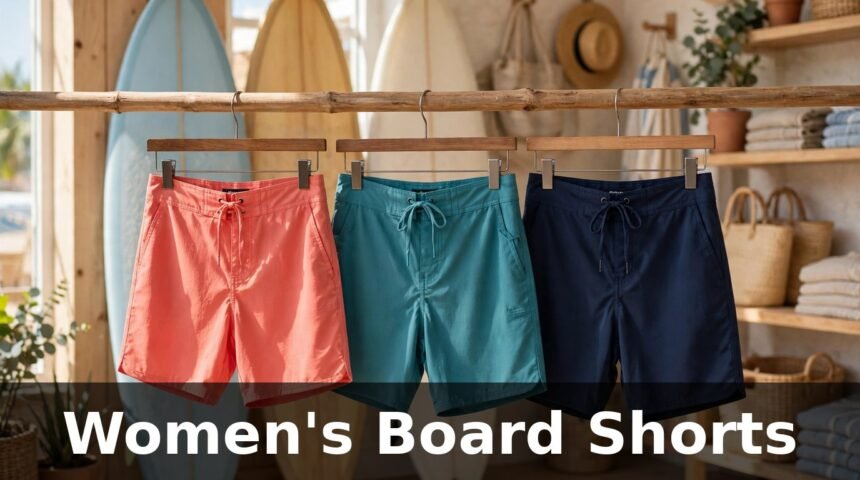
A good pair of women’s board shorts is one of the most useful things you can own for warm weather. They work in the surf, at the pool, on a paddleboard, on a boat, and on a beach walk, and they are comfortable enough to wear long after you are out of the water. Yet shopping for them can be surprisingly fiddly. Lengths vary from barely-there to below the knee, waistbands range from fixed to fully adjustable, and fabrics differ in how fast they dry, how much they stretch, and how they hold up in salt water.
The trick is to match the shorts to what you will actually do in them. A pair made for surfing has different priorities from a pair made for lounging by the pool, and a pair that fits perfectly when dry may ride up or loosen once it is wet. This guide explains the styles, lengths, fabrics, and fits available, how to choose by activity, how to get the sizing right, and how to care for your shorts so they last more than one summer.
More Information: When Is the Next Meteor Shower? Peak Dates for 2026
What Are Women’s Board Shorts?
Women’s board shorts are swim shorts designed for active use in and around the water. They originated in surf culture, where surfers needed shorts that would stay put while paddling and standing up on a board, dry quickly between sessions, and resist the chafing that comes from hours of salt water and wax. Over time they moved beyond surfing and became a general warm-weather staple.
Unlike ordinary swim bottoms, board shorts are built for movement and durability. They usually have a longer leg than a bikini bottom, a waistband designed to stay in place during activity, and a fabric that combines stretch with quick drying. They are cut for a woman’s shape, with a shaped waist, a contoured seat, and a leg opening that follows the thigh rather than cutting straight across it. Many styles also include practical details such as a drawstring waist, a small pocket, and flat seams that sit comfortably against the skin.
Board shorts are not the same as swim shorts made for casual wear, although the two overlap. A casual swim short might prioritise a soft feel and a pretty print, while a board short prioritises staying power, coverage, and resistance to wear. The best pairs manage both, which is why they have become popular far beyond the surf community.
Women’s Board Short Styles
Board shorts come in a wide range of styles, and the differences are more than cosmetic. The style you choose affects coverage, comfort, freedom of movement, and how the shorts look with the rest of your swimwear.
Classic Board Shorts
The classic women’s board short sits at the natural waist or just below it, with a straight leg that ends somewhere between mid-thigh and just above the knee. It is the most versatile style: long enough to give good coverage and prevent chafing on a board, short enough to move freely, and neutral enough to pair with a rash guard, a bikini top, or a tank top. If you are buying your first pair and you are not sure what you need, the classic style is the safest starting point.
High-Waisted Board Shorts
High-waisted board shorts sit at or above the natural waist, giving extra coverage through the midsection and a retro-inspired silhouette. They suit people who want more support around the waist, who prefer a vintage look, or who want the shorts to overlap with a bikini top or crop top without a gap. The higher waist also helps the shorts stay in place during active swimming and surfing, because there is more fabric gripping the waist. They can feel warm in very hot weather, and they look best when the top is short enough to show the waistband or tucked in.
Short Board Shorts
Short board shorts, sometimes called shorties, have a shorter inseam and end high on the thigh. They give the most freedom of movement and the least coverage, and they dry fastest because there is less fabric. They suit confident swimmers and surfers who want maximum mobility, and they work well as a layer over a swimsuit. The trade-off is coverage: they offer less protection from sun and chafing than longer styles, and they can ride up during vigorous activity if the fit is not right.
Long Board Shorts
Long board shorts extend to the knee or just below it, giving the most coverage of any style. They are a good choice for people who want sun protection on their thighs, who are prone to chafing, or who simply prefer a modest cut. They are also popular for stand-up paddleboarding and kayaking, where the thighs spend a lot of time in contact with the board or the boat. The extra length can feel heavy when wet, and it takes longer to dry, so look for a lightweight fabric if you choose this style.
Performance and Surf-Specific Shorts
Performance board shorts are designed with surfing in mind. They typically use a four-way stretch fabric, a secure drawstring waist, minimal seams to reduce chafing, and a close, athletic fit that does not flap in the water. Some have a scalloped hem that allows more leg movement, and some include a small key pocket or a loop for a leash. These are the shorts to choose if you surf regularly or do other high-energy water sports. For casual swimming and lounging, their technical features matter less, and a simpler style may be more comfortable.
Hybrid and Athleisure Board Shorts
Hybrid board shorts blur the line between swimwear and everyday clothing. They look like regular shorts, with a more tailored cut and details such as belt loops or a button fly, but they are made from quick-drying swim fabric. They are designed to go from the beach to a cafe without a change of clothes, and they suit people who want one pair that covers both swimming and walking around town. They are not usually the best choice for serious surfing, because the fit is looser and the waistband is less secure, but for a holiday where the beach and the town are both on the agenda, they are very practical.
Lengths and Coverage: How to Choose
Length is the single biggest decision when buying women’s board shorts, because it affects comfort, coverage, and performance more than any other factor. Lengths are usually described by inseam, the measurement from the crotch to the hem, and common women’s inseams run from about two inches in the shortest styles to nine inches or more in the longest.
A short inseam of two to three inches gives a sporty, minimal feel and the most freedom of movement. It suits strong swimmers and surfers who want nothing in the way, and it dries quickly. The downside is limited coverage and a greater chance of riding up during activity, especially if the fabric is very stretchy.
A mid-length inseam of four to six inches is the most popular choice, and for good reason. It covers the upper thigh, reduces chafing on a surfboard or paddleboard, and still allows a full range of movement. Most women find this length the most comfortable for a mix of swimming, surfing, and walking, and it pairs well with most swim tops.
A long inseam of seven to nine inches gives full thigh coverage and the best sun protection. It suits people who are sensitive to sun, who chafe easily, or who want a modest cut. It is also a good choice for paddleboarding and kayaking, where the thighs are in constant contact with a hard surface. The trade-off is weight when wet and a slower drying time, and some people find the longer leg restrictive when swimming hard.
When you are deciding, think about the activity first and the look second. A length that looks right standing in front of a mirror can feel very different when you are paddling, duck-diving under a wave, or climbing back onto a board. If you can, try the shorts on and move in them: squat, lift your knees, and twist at the waist. The hem should stay roughly where you want it through all of that. If it rides up or pulls across the thigh, try a different length or a different cut.
Fabrics and What They Do
The fabric of a board short matters as much as the cut. It decides how the shorts feel when wet, how fast they dry, how much they stretch, and how long they last.
Most women’s board shorts are made from a blend of recycled polyester and elastane, often called spandex. Polyester gives the fabric its strength, its resistance to chlorine and salt water, and its ability to dry quickly. Elastane gives it stretch, usually between ten and twenty percent of the blend, which lets the shorts move with your body without bagging out. A blend with more elastane feels softer and stretchier but can lose its shape faster over time, while a blend with less elastane holds its shape better but feels firmer.
Some shorts use nylon instead of polyester. Nylon is softer to the touch and has a smooth, silky feel that many people prefer against the skin. It dries quickly and stretches well, but it is less resistant to chlorine than polyester, so it can fade and weaken faster if you swim in pools often. If you mostly swim in the sea, nylon is a fine choice. If you mostly swim in a chlorinated pool, polyester will last longer.
Look for a fabric weight that suits your use. A lightweight fabric, often described as featherweight or ultralight, dries fastest and feels barely there, which suits hot climates and long days in the water. A heavier fabric feels more substantial, holds its shape better, and gives more coverage when wet, but it takes longer to dry and can feel heavy in the water. For surfing, a medium-weight four-way stretch fabric is usually the best compromise.
Other fabric features worth checking are UPF sun protection, which many board shorts now include, and a water-repellent finish, which helps the fabric shed water and dry faster. Both are useful, but neither replaces sunscreen on the rest of your skin. Flatlock seams, where the seam is stitched flat against the fabric rather than raised, reduce chafing during long sessions in the water and are worth looking for if you surf or paddle for hours at a time.
Fit and Waistbands
A board short that fits well should feel secure without squeezing, and it should stay in place when you move. The waistband does most of that work, so it deserves attention when you are choosing.
The most common waistband is a drawstring waist with an elasticated back. The elastic gives flexibility and comfort, while the drawstring lets you tighten the fit and lock the shorts in place. This is the best option for active use, because you can adjust the fit to your body and to whether the shorts are wet or dry. A drawstring that runs through the front of the waistband is easier to adjust than one hidden inside, and a flat drawstring is less likely to dig in than a round cord.
Some board shorts have a fixed waistband with a button or zip closure, similar to regular shorts. These look smarter and suit hybrid styles that double as everyday shorts, but they offer less adjustment and can loosen when wet, because swim fabric relaxes in water. If you choose a fixed waistband for swimming, make sure the fit is snug when dry, so it stays secure when wet.
High-waisted styles usually have a wide, smooth waistband without a drawstring, relying on the fabric’s stretch and the extra coverage to hold the shorts in place. These can be very comfortable, but they depend heavily on getting the size right, because there is no drawstring to take up the slack.
When you try board shorts on, check the fit in three places. The waist should sit comfortably without digging in or gaping at the back. The seat should follow your shape without pulling tight across the hips or bagging loosely. The leg opening should sit flat against the thigh without cutting in. Walk, squat, and sit in them. If the waistband rolls down when you bend, or the legs ride up when you walk, the fit is not right, and a different size or style will serve you better.
How to Choose Board Shorts by Activity
The best board short for you depends on what you will do in it most. The table below is a starting point, but your body shape and personal preference still matter, so treat it as guidance rather than a rule.
For surfing, choose a performance board short with four-way stretch, a drawstring waist, flat seams, and a mid-length leg. The stretch lets you move freely on the board, the drawstring keeps the shorts in place through wipeouts, and the flat seams reduce chafing during long sessions. A mid-length leg protects the thighs from wax and board rash without getting in the way of your stance.
For swimming, choose a lightweight short with a comfortable waistband and a shorter or mid-length leg. You want as little drag as possible in the water, and you want the shorts to dry quickly when you get out. A high-waisted style can work well for swimming, because it stays in place during strokes and turns.
For stand-up paddleboarding and kayaking, choose a mid-length or long board short. Your thighs spend a lot of time in contact with the board or the boat, so the extra coverage prevents chafing and sunburn. A lightweight, quick-drying fabric matters here, because you will be in and out of the water and in the sun for hours.
For beach volleyball and other beach sports, choose a short or mid-length style with plenty of stretch. You need freedom of movement for jumping and diving, and a shorter leg keeps the shorts out of the way. A drawstring waist helps the shorts stay put during fast movements.
For lounging, walking, and casual wear, choose whichever style you find most comfortable and best looking. Coverage, drying speed, and stretch matter less here, so you can prioritise the cut and the print you like. Hybrid board shorts are a good option for this, because they look like regular shorts and can take you from the beach to lunch without a change of clothes.
If you do more than one of these activities regularly, consider owning two pairs: a performance pair for surfing or swimming, and a casual pair for lounging and walking around. One pair that tries to do everything often does nothing particularly well.
More Information: Adidas Women’s VL Court Bold: Style, Fit and Where to Buy
Sizing Tips for Women’s Board Shorts
Sizing is where most board short purchases go wrong, because swimwear sizes vary between brands and because wet fabric behaves differently from dry fabric. A few practical steps will save you a return.
Start with the brand’s size chart, not your usual dress size. Board short sizes are usually given in standard dress sizes or in letter sizes, and the measurements that matter are waist and hip. Measure your waist at its narrowest point and your hips at their widest, then compare those numbers with the chart. If you fall between sizes, the right choice depends on the style: for a drawstring waist, size down, because you can tighten the drawstring to take up the slack; for a fixed waistband or a high-waisted style, size up, because there is no drawstring to compensate.
Remember that swim fabric stretches when wet. A pair that feels snug in the changing room may feel perfect in the water, while a pair that feels comfortable dry may loosen once it is soaked. This is why a secure waistband matters so much: the drawstring lets you adjust for the change. When you try shorts on, pull gently on the waistband and the leg openings. If the fabric gives a lot, expect the shorts to loosen further when wet.
Think about what you will wear underneath. Some women wear board shorts on their own, while others wear them over a swimsuit bottom. If you plan to layer them, try them on over the swimsuit you will wear with them, because the extra layer changes the fit. If you wear them on their own, check whether the shorts have a mesh lining or a brief built in, because that affects comfort and support.
Check the rise as well as the waist measurement. Rise is the distance from the crotch to the top of the waistband, and it decides where the shorts sit on your body. A low rise sits on the hips, a mid rise sits just below the natural waist, and a high rise sits at or above it. If you have a long torso, a low-rise short may sit uncomfortably low. If you have a short torso, a high-rise short may feel too long. The rise is rarely listed on the size chart, but it is usually visible in the product photos, so look at where the waistband sits on the model.
Finally, if you are buying online, check the return policy before you order. Swimwear is one of the hardest things to buy without trying on, and a clear, easy return policy is worth more than a small discount. Order two sizes if you are unsure, try both on at home, and return the one that does not fit.
Colours, Prints and Styling
Board shorts come in every colour and print imaginable, from solid black to bold tropical patterns, and the choice is mostly personal. A few practical points are worth keeping in mind.
Dark, solid colours are the most versatile. They pair with any top, they show water marks and salt stains less than pale colours, and they tend to fade less noticeably over time. Black, navy, and deep green are safe choices that work for every activity and every setting.
Bold prints and bright colours look great on the beach, and they are a good way to express personal style. Keep in mind that prints can fade with sun and chlorine, so a high-quality print on a chlorine-resistant fabric will hold its colour longer than a cheap print on a basic fabric. If you swim in pools often, a darker print will hide fading better than a pale one.
For styling, board shorts pair naturally with a bikini top, a sports-style swim top, or a rash guard. A rash guard is a practical choice for surfing and paddleboarding, because it protects your shoulders and torso from sun and chafing, and it looks good with board shorts in any length. A cropped top or a tank top works well for casual wear, especially with high-waisted shorts. For a day that includes both the beach and town, a loose linen shirt or a light cover-up over the shorts makes the outfit feel complete without a change of clothes.
Common Mistakes When Buying Women’s Board Shorts
A few mistakes come up again and again, and they are easy to avoid once you know them.
The first is choosing by looks alone. A beautiful print will not help if the shorts ride up, loosen in the water, or chafe after an hour on a board. Fit and fabric come first, and style comes second. The good news is that most brands now offer their best technical shorts in a wide range of colours and prints, so you rarely have to choose between the two.
The second is buying the wrong length for the activity. Very short shorts look good on the beach but offer little protection from sun and chafing on a surfboard. Very long shorts give great coverage but can feel heavy and slow to dry when swimming. Match the length to the activity, not just to the look you like in the mirror.
The third is ignoring the waistband. A fixed waistband without a drawstring can be fine for lounging, but it is a poor choice for surfing, where the shorts need to stay put through a wipeout. If you surf, a drawstring waist is not optional.
The fourth is buying a size based on your usual dress size without checking the brand’s chart. Swimwear sizing varies widely between brands, and a size eight in one brand can be a size ten in another. Measure yourself and use the chart.
The fifth is forgetting that swim fabric stretches when wet. A pair that fits perfectly in the shop may be loose in the water. Buy for a snug dry fit, and rely on the drawstring to adjust.
How to Care for Women’s Board Shorts
Good care will make a pair of board shorts last for several summers instead of one. The routine is simple, but it is worth following.
Rinse your shorts in fresh, cool water after every swim, especially after salt water or a chlorinated pool. Salt and chlorine both break down swim fabric over time, and rinsing removes them before they can do damage. A quick rinse under a tap or a shower is enough.
Wash them by hand with a mild detergent when they need a proper clean, and avoid the washing machine where possible. Machine washing, especially on a hot cycle, weakens the elastane and fades the print. If you do use a machine, use a cold, gentle cycle and a mesh laundry bag.
Dry them in the shade, not in direct sun and not in a tumble dryer. Heat is the enemy of swim fabric: it breaks down the stretch fibres and fades colours. Hang the shorts in a shaded, airy place and let them dry naturally. Do not wring them out hard, because that stretches the fabric. Press the water out gently instead.
Store them dry, folded rather than hung, and keep them away from rough surfaces such as Velcro, which can snag the fabric. With this care, a good pair of board shorts should keep its shape, its stretch, and its colour for several seasons. When the waistband stops holding, the fabric goes thin, or the stretch does not recover after washing, it is time to replace them.
Frequently Asked Questions
What are women’s board shorts?
Women’s board shorts are swim shorts designed for active use in and around the water. They originated in surf culture and are built for movement, durability, and quick drying. They have a longer leg than a bikini bottom, a waistband designed to stay in place during activity, and a stretch fabric that resists salt water and chlorine. They are cut for a woman’s shape and are now worn for surfing, swimming, paddleboarding, and general beach wear.
What length of board shorts should I get?
It depends on what you will do in them. A short inseam of two to three inches gives the most freedom of movement and dries fastest. A mid-length inseam of four to six inches is the most versatile, giving good coverage and comfort for a mix of swimming, surfing, and walking. A long inseam of seven to nine inches gives the most coverage and sun protection, and suits paddleboarding and kayaking. For a first pair, a mid-length style is usually the best choice.
Do women’s board shorts run true to size?
Sizing varies between brands, so always check the brand’s size chart and measure your waist and hips rather than relying on your usual dress size. Swim fabric stretches when wet, so a pair that feels snug when dry often fits best in the water. If you are between sizes, size down for a drawstring waist, because you can tighten it, and size up for a fixed or high-waisted style, because there is no drawstring to take up the slack.
Should board shorts be tight or loose?
Board shorts should feel secure without squeezing. The waist should sit flat without gaping or digging in, the seat should follow your shape without pulling tight, and the leg opening should sit flat against the thigh. They should not be so tight that they restrict movement or cut in, and not so loose that they shift or fall when wet. A drawstring waist helps you get the fit right for your body and adjust it when the shorts are wet.
What is the best fabric for women’s board shorts?
A blend of recycled polyester and elastane is the most common and the most practical choice. Polyester gives strength, chlorine and salt resistance, and quick drying, while elastane gives stretch. Nylon blends are softer and feel smoother against the skin, but they are less resistant to chlorine. For pool swimming, polyester is the better choice. For sea swimming, either works well. Look for four-way stretch, flat seams, and UPF sun protection if you spend long hours in the water.
Can you wear board shorts for swimming?
Yes, board shorts are made for swimming, and they are a popular choice for women who want more coverage than a bikini bottom, or who want a single pair of shorts that works for swimming, surfing, and walking. Choose a lightweight style with a secure waistband for swimming, because heavy fabric creates drag and takes longer to dry. Short or mid-length styles are usually best for swimming, because they move freely and dry quickly.
How do you stop board shorts from riding up?
Riding up is usually a sign of the wrong length or fit. A longer inseam gives more fabric to stay in place, and a closer, athletic cut with a grippy leg opening is less likely to shift than a loose cut. Make sure the size is right: shorts that are too small ride up because the fabric is stretched tight, and shorts that are too big ride up because there is nothing holding them in place. A drawstring waist tightened properly also helps, because it anchors the shorts at the waist.
How do you wash women’s board shorts?
Rinse them in fresh, cool water after every swim to remove salt and chlorine. Wash them by hand with a mild detergent when they need a proper clean, and avoid hot machine cycles and tumble dryers, because heat damages the stretch fibres and fades the print. Dry them in the shade, press the water out gently instead of wringing, and store them dry and folded.
Conclusion
Women’s board shorts are one of the most practical pieces of swimwear you can own, and choosing the right pair comes down to a few simple decisions. Start with the activity: surfing calls for a stretch performance short with a drawstring waist, swimming calls for something lightweight and quick drying, paddleboarding calls for a longer leg, and lounging calls for whatever you find most comfortable. Choose the length that gives you the coverage you want without getting in your way, and choose a fabric that dries fast and holds up in salt water or chlorine.
Then get the fit right. Measure yourself, use the brand’s size chart, and remember that swim fabric stretches when wet, so a snug dry fit is usually the right one. Pay attention to the waistband, because it is what keeps the shorts in place, and try the shorts on over the swimsuit you will wear with them if you plan to layer.
Get those basics right and the rest is easy. A good pair of women’s board shorts will stay put in the surf, dry quickly in the sun, and last for several summers with simple care. Choose for what you will actually do in them, and they will do the job well.
Read Also: Schachter and Singer’s Theory of Emotion (2026 Guide)