

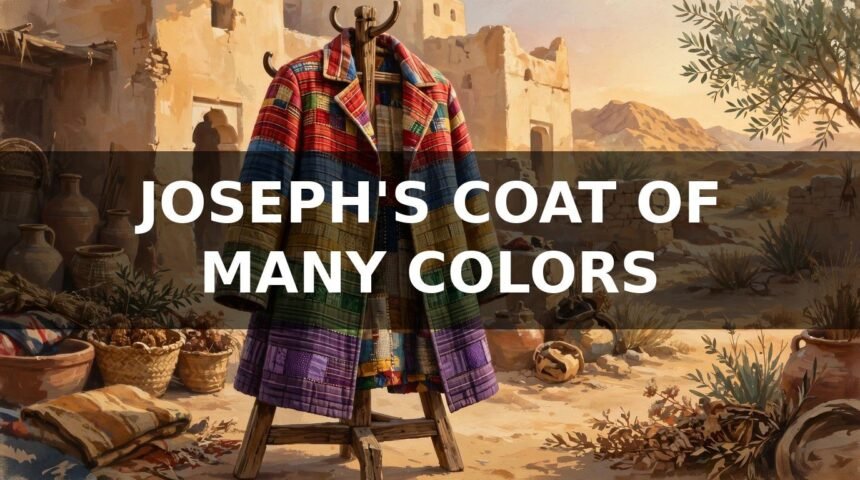
Few objects in the Bible are as instantly recognisable as Joseph’s coat of many colors. Even people who have never read Genesis have heard of it, seen it in a school play, or hummed a song about it. It sits at the centre of a family story full of love, jealousy, betrayal, and, in the end, forgiveness.
The short answer is that the coat was a gift from Jacob to his son Joseph, and it was far more than a piece of clothing. In a household where favour was usually shown quietly, this robe announced it in public: Jacob loved Joseph more than his brothers, and Joseph was being set apart for something greater. That message, more than the colours themselves, turned a family into enemies.
What Is Joseph’s Coat of Many Colors?
Joseph’s coat of many colors was a special robe that Jacob, also called Israel, gave to his son Joseph when Joseph was seventeen years old. The Bible introduces it in Genesis 37:3, in a verse that explains the gift in the same breath as the reason for it: Jacob loved Joseph more than any of his other sons because Joseph had been born to him in his old age, so he made him an ornate robe.
Joseph was not the eldest son. He was the eleventh of Jacob’s twelve sons, and the first son of Rachel, the wife Jacob loved most. His older brothers had worked in the fields for years. Joseph, by contrast, was given a garment that marked him out from them the moment he walked into a room.
In the ancient world, clothing said a great deal about a person. Most working people wore simple, plain tunics that stopped at the knee and left the arms free. A long, decorated robe was different: expensive to make, hard to keep clean, and completely impractical for shepherding sheep. Wearing one was a statement that this person did not do ordinary manual work and held a special place in the family. The coat was never just about colour. It was about status, and the brothers understood the message perfectly.
The Story Behind the Coat
Joseph, the Favoured Son
Joseph was seventeen when the story begins, old enough to work with his brothers tending the flocks. The Bible says he brought his father a bad report about his brothers, the sons of Bilhah and Zilpah. The effect was to widen the gap between Joseph and his brothers even further, and it confirmed in their eyes that Joseph was his father’s spy as well as his favourite.
Then came the coat, and Joseph wore it openly. Every time his brothers saw it, they were reminded of their father’s preference. The Bible puts it bluntly: when they saw that their father loved Joseph more than any of them, they hated him and could not speak a kind word to him. The coat had become a daily, visible reminder of a wound in the family, and every sighting of it reopened that wound.
The Dreams That Made Things Worse
If the coat lit the fuse, Joseph’s dreams lit the match. Soon after receiving the robe, Joseph had two dreams, and he told both of them to his brothers. In the first, Joseph and his brothers were binding sheaves of grain in a field. Joseph’s sheaf rose up and stood upright, while his brothers’ sheaves gathered around it and bowed down to it. In the second, the sun, the moon, and eleven stars bowed down to Joseph.
The meaning was not hard to work out: Joseph was dreaming that he would one day rule over his brothers, and even over his parents. His brothers angrily asked whether he really intended to reign over them, and even Jacob rebuked him. But the Bible adds a telling detail: Jacob kept the matter in mind.
The Coat Is Taken Away
The crisis came when Jacob sent Joseph to check on his brothers, who were grazing the flocks near Shechem and then at Dothan. Joseph set out wearing his coat, and his brothers saw him coming from a distance. Before he reached them, they had already decided what to do. They plotted to kill him and tell their father a wild animal had torn him apart.
Reuben, the eldest brother, persuaded them not to kill Joseph outright. Instead they stripped him of his coat, threw him into an empty pit, and sat down to eat. While they ate, a caravan of traders passed by on its way to Egypt, and Judah suggested selling Joseph to them instead. The brothers agreed. Joseph was pulled out of the pit and sold for twenty pieces of silver.
Then came the cruellest use of the coat. The brothers took Joseph’s robe, killed a goat, dipped the robe in its blood, and carried it back to Jacob. He recognised it at once, concluded that a wild animal had devoured his son, and mourned for Joseph for many days, refusing to be comforted. The coat that had announced Joseph’s favoured place in the family was now the evidence used to convince his father that he was dead.
What Did the Coat Actually Look Like?
The honest answer is that nobody knows exactly what the coat looked like. The famous phrase “coat of many colors” comes from the King James Version of the Bible, and it has shaped how generations of readers picture the garment. But the original Hebrew is less clear than the English suggests, and Bible scholars have debated it for centuries.
The Hebrew phrase used in Genesis 37:3 is “ketonet passim.” The first word means a tunic or robe. The second word, “passim,” is the difficult one. It is a rare word, and its exact meaning is uncertain. Some scholars connect it to the palms and soles, suggesting a garment reaching the wrists and ankles. Others connect it to embroidery or stripes, suggesting a robe decorated with patterns of different colours.
Modern translations reflect that uncertainty. The New International Version calls it an “ornate robe.” The English Standard Version keeps the traditional “robe of many colors.” The New Revised Standard Version calls it an “ornamented robe” and adds a footnote saying the meaning of the Hebrew is uncertain. The Septuagint, the ancient Greek translation, used a word meaning “many-coloured,” and that is where the familiar English phrase comes from.
| Translation | How it describes the robe | What it emphasises |
|---|---|---|
| King James Version | Coat of many colors | The many colours |
| New International Version | Ornate robe | Decoration and richness |
| English Standard Version | Robe of many colors | The traditional image |
| New Revised Standard Version | Ornamented robe | Decoration, with a note that the Hebrew is uncertain |
What Does Joseph’s Coat of Many Colors Mean?
The meaning of Joseph’s coat of many colors works on several levels at once. It meant one thing to Jacob, another to Joseph, and something else entirely to his brothers. And for readers today, it has come to mean something broader still: a picture of how favour, calling, and suffering can be woven together in one life.
A Sign of a Father’s Love
At its simplest, the coat was a father’s gift to a beloved son. Jacob loved Joseph because he was the son of his old age and the first son of Rachel, the wife he had waited fourteen years to marry. The coat was Jacob’s way of expressing that love in a form everyone could see.
A Symbol of Leadership and Authority
The coat also carried a message about Joseph’s future. In the ancient world, a long robe was not work clothing. It was the clothing of someone who supervised others rather than labouring alongside them. When Jacob dressed Joseph in such a robe, he was effectively telling his older brothers that their younger brother would one day be set over them. The dreams confirmed it.
What makes the story so compelling is that the brothers were right about what the coat meant, and wrong about what to do with it. Joseph did eventually rise to great authority as the second most powerful man in Egypt, and his brothers did eventually bow before him. The brothers simply could not accept that the younger son, the dreamer, the favourite, would be the one God chose.
A Picture of God’s Favour and Calling
For many readers, the coat has a deeper meaning as well. It is a picture of a calling that comes from God, not from a person’s own efforts. Joseph did nothing to earn the robe. He did not buy it, make it, or ask for it. His father gave it to him because he loved him, and the dreams came to him in the same way, as gifts he did not choose.
The Coat in the Rest of Joseph’s Story
The coat disappears from the story after Genesis 37, but what it stood for follows Joseph to Egypt and back. Sold as a slave to Potiphar, an officer of Pharaoh, Joseph rises to run his household, then loses everything again when Potiphar’s wife falsely accuses him, and he is thrown into prison. There he rises again to a position of trust, and after interpreting Pharaoh’s dreams of seven years of plenty followed by seven years of famine, he is raised to the highest office in Egypt, second only to Pharaoh himself.
When famine strikes the whole region, Joseph’s brothers come to Egypt to buy grain, and they bow down before the governor of Egypt without recognising him. The dream of the sheaves bowing down comes true, almost twenty years after Joseph first dreamed it. Joseph eventually reveals himself to his brothers, forgives them, and brings the whole family to Egypt.
Joseph’s Coat of Many Colors in Culture Today
Few Bible stories have travelled as far beyond the Bible as this one. The best-known example is the musical “Joseph and the Amazing Technicolor Dreamcoat,” created by Andrew Lloyd Webber and Tim Rice. It began as a short piece for a school choir in 1968 and grew into a stage musical performed all over the world. Its title song, with its long list of colours, has fixed the image of a brilliantly multicoloured coat in the public imagination, and it has introduced millions of people to Joseph.
Lessons From the Story of Joseph’s Coat
The first lesson is about favouritism. Jacob’s love for Joseph was real, but the way he showed it damaged his family. Parents and leaders who show open favour to one person while overlooking others should expect resentment, even when their affection is genuine. A gift that singles one person out in public will always be noticed by the people left out.
The second lesson is about how we handle being chosen. Joseph did not ask for the coat or the dreams, but he did not handle them wisely either. Telling his brothers about dreams in which they bowed down to him was honest, but it was also tactless, and it poured fuel on a fire that was already burning. Being given a gift or a position does not remove the need for humility and good judgement about when and how to speak.
The third lesson is about envy, and how quickly it can turn dangerous. The brothers’ hatred began with a feeling they could not speak about, and it ended with a plan to kill their own brother. Envy rarely stays small. Left unchecked, it grows into resentment, then into plotting, and then into actions that cannot be undone.
The fourth lesson is the one that gives the story its hope. Joseph’s life does not end in the pit. The coat is taken from him, but his character is not. He remains honest and faithful in slavery and in prison, and when he finally has power over the brothers who wronged him, he uses it to feed them rather than to punish them. Forgiveness is possible even after a deep betrayal.
Frequently Asked Questions
What does Joseph’s coat of many colors symbolise?
The coat symbolises Jacob’s special love for Joseph and Joseph’s set-apart position in the family. It marked Joseph out as his father’s favourite and hinted that he would one day hold authority over his brothers.
Why did Joseph’s brothers hate him because of the coat?
His brothers hated him because the coat was a public sign that their father loved Joseph more than them. In a family already divided by favouritism, the robe was a daily reminder that Joseph was treated differently. His dreams, in which his brothers bowed down to him, made it worse, and their jealousy turned into hatred.
What happened to Joseph’s coat of many colors?
His brothers stripped it from Joseph at Dothan, dipped it in goat’s blood, and showed it to Jacob, claiming a wild animal had killed Joseph. Jacob believed the lie and mourned for his son. The coat itself disappears from the story after that, and Joseph never gets it back.
Was Joseph’s coat really many colors?
That is uncertain. The Hebrew phrase “ketonet passim” is difficult to translate, and scholars disagree about whether it means many colours, stripes, embroidery, or a long robe. The “many colors” reading comes from the ancient Greek translation of the Bible. Whatever its exact appearance, it was a long, decorated robe of a kind worn by people of high status, not a working garment.
Conclusion
Joseph’s coat of many colors is a small object with a large meaning. It was a father’s gift, a sign of favour, a hint of leadership to come, and the spark that set a family tragedy in motion. It was also the first thing Joseph lost on a long road that would take him from a pit in Dothan to the highest office in Egypt.
What makes the story last is not the robe itself, but what happens around it. A family breaks apart over jealousy, a young man loses everything, and yet the story ends not with revenge but with forgiveness and reunion.
Read Also: Patagonia Women’s Retro Pile Marsupial (2026 Guide)