

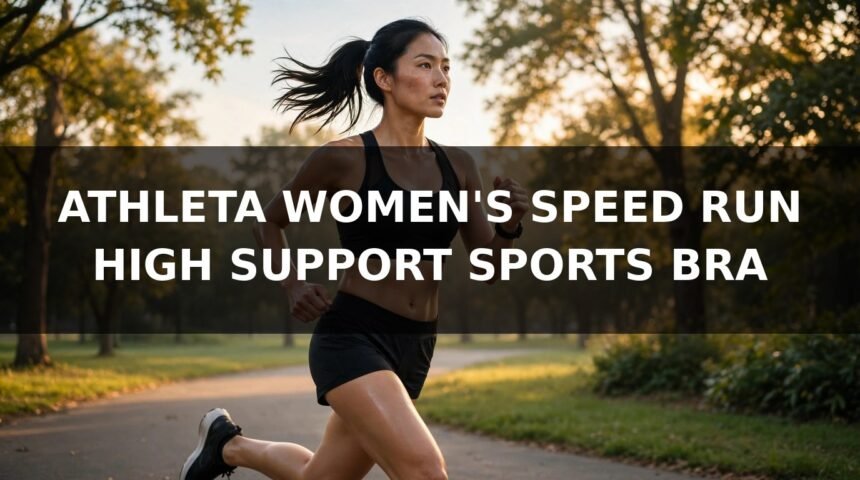
Finding a sports bra that actually holds up on a run is harder than it sounds. Plenty of bras look supportive on the hanger and then let you down at mile two. The Athleta Women’s Speed Run High Support Sports Bra is built for exactly that problem. It is a high-impact bra designed for running, training, and HIIT, with foam-enforced cups, adjustable racerback straps, and a sweat-wicking fabric that is meant to keep up with hard workouts. On Athleta’s own site it carries a 4.4 out of 5 star rating from close to 300 reviews, which tells you most buyers are happy with it, while a smaller group has real complaints worth knowing about before you spend your money.
This guide covers everything a buyer needs to decide. You will learn what the bra is made of, how the support actually works, who it fits best, how to pick your size, what real reviewers love and dislike, how it compares with other high-support bras in general terms, and how to care for it so it lasts. Whether you are a new runner buying your first high-support bra or an experienced runner replacing a worn-out favorite, you will find a straight answer here.
What Is the Athleta Women’s Speed Run High Support Sports Bra?
The short answer is that it is Athleta’s high-impact running bra, made for B to DD cup sizes, and built around compression plus structure rather than compression alone. Athleta lists it as best for cardio, meaning running, training, and HIIT. That matters because support needs change with the activity. A bra that feels fine for yoga can fail badly on a run, where every stride sends bounce through the chest. High-impact bras exist to control that movement, and this one is Athleta’s answer for runners.
Key takeaway: this is a purpose-built running bra for B to DD cups, not a general everyday sports bra.
The design in plain terms
The bra uses foam-enforced cups and straps. That is the detail Athleta highlights first, and it is the feature reviewers mention most. The molded foam cups give shape and hold without removable pads, which is a genuine plus. Removable pads bunch up in the wash, fold over, and disappear into the laundry. Built-in molded cups stay put. Several reviewers specifically praise this, with one calling molded cups the reason she bought the bra and another saying she loves that there are no pads to fall out and get crumpled in the wash.
The straps are adjustable and sit in a racerback layout. Adjustable straps matter more than most buyers realize. A fixed strap forces you to accept whatever fit the factory chose. An adjustable strap lets you tighten the lift where you need it and loosen it where you do not. The racerback shape also keeps straps from sliding off the shoulders during arm swing, which is a common annoyance on long runs.
Mesh panels are built into the design to invite airflow. Running generates heat fast, and a bra that traps sweat against the skin gets uncomfortable and can chafe. Mesh panels are not a magic fix, but they do help the bra breathe in the areas where heat builds up most.
Fabric and care
The fabric is 67 percent nylon and 33 percent spandex. That blend is standard for performance activewear for a reason. Nylon is strong and dries quickly. Spandex gives the snap-back stretch that lets the bra compress firmly and then return to shape instead of sagging out over time. Athleta describes the feel as supportive compression with snap-back stretch that will not restrict or shift, and the fabric is quick-drying and sweat-wicking, pulling moisture away from the body so it can evaporate.
Care is simple. Machine wash cold and tumble dry on low. That is the official guidance from Athleta. In practice, most runners get longer life from sports bras by washing them in cold water, skipping fabric softener, and air-drying when possible, because heat is what breaks down spandex over time. The official care label allows the dryer on low, so you are not breaking any rule by using it, but air-drying is the gentler choice if you want the bra to keep its compression for as many months as possible.
Sizes and price
Athleta designs this bra for B to DD cups. The listed sizes run from 32C through 40DD, including 32C, 32D, 32DD, 34B, 34C, 34D, 34DD, 36B, 36C, 36D, 36DD, 38B, 38C, 38D, 38DD, 40C, 40D, and 40DD. If you wear an A cup or anything above DD, this bra is not designed for you, and you will be better served by a bra built for your range.
The listed price on Athleta’s site is 69 dollars. Prices and promotions change often, and Athleta runs sales regularly, so treat that figure as the current list price as of late November 2026 rather than a permanent number. Check the live price before you buy, and look for seasonal promotions if the full price feels steep.
Who Is This Bra For?
The short answer is that it suits runners and high-impact trainers in the B to DD range who want strong support without removable pads. But that covers a lot of different people, so it helps to break it down by reader.
Key takeaway: B to DD runners doing running, HIIT, or hard training are the core audience, and fit depends on your cup size and your tolerance for compression.
Beginner runners
If you are just starting to run, your first high-support bra matters more than your shoes in one specific way. Bad support makes running uncomfortable from the first week, and discomfort is one of the main reasons new runners quit. A beginner does not need the most expensive bra on the market, but she does need one that controls bounce and stays comfortable for the full run.
This bra is a reasonable first high-support buy for a beginner in the B to DD range. The molded cups mean there is nothing to adjust or lose, the adjustable straps let you dial in the fit as you learn what works, and the compression feel is firm without being punishing. One reviewer who described herself as a new runner said she searched for a long time for a supportive bra and, as a 34D, barely felt any movement in this one while running. That is exactly the experience a beginner wants.
One caution for beginners is the fit. Several reviewers report that the bra runs large, with one buyer saying it was way too big and uncomfortable in her usual size 32. Athleta’s own fit data shows an average overall-size rating of 1.9 on a scale where 2 is true to size, which suggests a slight tendency to run large. A beginner should measure carefully, check Athleta’s size guide, and be ready to exchange if the first size is off. That is normal for sports bras and not a reason to avoid the product.
Experienced runners
Experienced runners usually know exactly what they want: minimal bounce, no chafing, straps that stay put, and a bra that survives dozens of wash cycles. This bra checks most of those boxes. The foam-enforced cups and straps are designed to hold strong through the push, and the quick-dry fabric handles sweat on longer efforts.
The main question for experienced runners is whether the support is enough at their cup size and pace. A 34D reviewer reported almost no movement while running, which is a strong signal. But support is personal. A runner who does tempo runs and long runs will stress a bra more than a runner doing easy three-milers. If you are training for a half marathon or marathon, try the bra on a shorter run first, then a long run, before trusting it on race day. Never race in gear you have not tested on a long run. That rule applies to every bra, not just this one.
Larger busts within the B to DD range
For C and D cup runners, this bra is aimed squarely at you. The B to DD design range means the structure, strap width, and cup shape were built with your needs in mind. The adjustable straps are especially useful here, because larger busts need more lift, and a fixed strap cannot provide it.
That said, the upper end of the range deserves honesty. Some DD reviewers love the bra, while others find the fit tricky. If you are a DD and between sizes, the brand’s own fit feedback leaning slightly large suggests trying your usual size first and exchanging if needed, rather than sizing up by default. And if you are above DD, this is simply not your bra. Athleta makes other styles for other ranges, and a bra designed for a bigger cup will serve you better than forcing this one to do a job it was not built for.
Smaller busts and low-impact use
If you are a B cup, this bra will give you firm support, possibly more than you need for light activity. That is not a flaw. Some B cup runners prefer a lighter bra for easy days and save the high-support bra for hard workouts. There is nothing wrong with owning both. But if you only do yoga, walking, or light gym work, a high-support running bra is overkill. You would be paying for structure you do not use, and the firm compression may feel restrictive for gentle movement. This bra earns its keep on runs, HIIT sessions, and training days.
How the Support Actually Works
Understanding how a high-support bra works helps you judge whether this one will work for you. Support comes from three places: the band, the cups, and the straps. Most buyers focus on the cups, but the band does most of the work.
Key takeaway: the band carries most of the support, the molded cups control shape and bounce, and the adjustable straps fine-tune the lift.
Compression plus structure
Many sports bras rely on compression alone. They squeeze everything flat and hope that is enough. That works for smaller busts and lower impact, but it often fails for larger busts at running pace. This Athleta bra pairs compression with structure. The fabric compresses firmly, and the foam-enforced cups add shape and hold that plain compression cannot provide. The result is support that feels secure without needing to be crushingly tight.
The snap-back stretch in the fabric matters here too. A bra that stretches out during a run and stays stretched is a bra that stops supporting you halfway through. Spandex gives the fabric memory, so it pulls back after each movement. That is why the 33 percent spandex content is worth noting. It is a high share, and it is part of why the bra holds its shape.
The band does the heavy lifting
In any bra, sports or everyday, the band around your ribcage provides most of the support, not the straps. If the band is too loose, the bra rides up and the straps dig in as they try to compensate. If the band is too tight, it digs in and restricts breathing. The right band should sit level around your body, feel snug on the loosest hook when new, and stay in place when you raise your arms.
When you try this bra on, check the band first. Jump in place a few times. Raise your arms overhead. The band should not ride up. If it does, the size is wrong, and no amount of strap adjustment will fix it. This is the single most useful fit test you can do in a fitting room.
Straps and racerback design
The adjustable racerback straps serve two purposes. First, they let you set the lift. Second, the racerback layout pulls the straps toward the center of the back, which keeps them from slipping off the shoulders during arm swing. Some reviewers praise the adjustable straps as one of the two best features of the bra, alongside the molded cups.
There is a complaint worth noting. One reviewer found the back straps dug into her back and wished the design sat flush against the skin. Another reviewer described the bra as impossible to get on, which points to a tight pullover entry. These are real trade-offs of the design. A racerback pullover bra will always be harder to get on and off than a front-zip or hook-back bra, because you have to pull it over your head and shoulders. If you have limited shoulder mobility or you hate wrestling with a tight pullover after a sweaty run, that is a genuine drawback to weigh.
Sizing and Fit Guide
Getting the size right is the difference between loving this bra and returning it. Sports bra sizing is less forgiving than everyday bra sizing because the fit has to survive movement, sweat, and hours of wear.
Key takeaway: measure before you order, expect the fit to lean slightly large, and test the band, straps, and bounce before you commit.
How to measure yourself
You need two measurements. First, measure your band size by wrapping a soft tape measure snugly around your ribcage, just under your bust, keeping the tape level. Second, measure your bust at the fullest point, keeping the tape level but not tight. The difference between the two numbers points to your cup size, and Athleta’s size guide converts those numbers into a size. If you are between sizes, the brand’s fit feedback leans slightly large, so your usual size is the safer starting point.
If you can visit an Athleta store, do it. A professional fitting takes a few minutes and removes the guesswork. Several shoppers report that in-store fitting helped them find the right size quickly, including one who was fitted two months after giving birth and walked out with a bra that fit properly. If you are ordering online, measure twice and keep the receipt. Exchanges are part of the process.
The fit checks that matter
Once the bra is on, run through these checks before you decide to keep it.
- The band sits level and snug, and it does not ride up when you raise your arms.
- The straps sit comfortably on your shoulders without digging in, and you can adjust them to a lift that feels secure.
- The molded cups lie smooth against your chest with no gaps and no spillage.
- You can take a full deep breath without the band restricting you.
- A few jumps in place produce minimal bounce and no pain.
If the band rides up, the size is too big. If the cups gap, the cup is too big or the style does not match your shape. If breast tissue spills over the top or sides, the cup is too small. If the straps dig in even after adjustment, the band may be too loose and the straps may be carrying weight they should not carry.
What reviewers say about fit
Reviewer feedback on fit is mixed, which is normal for a fitted garment. The overall rating of 4.4 out of 5 stars from close to 300 ratings shows most buyers are satisfied. Positive reviewers call out great support, excellent coverage, and true-to-size fit. One said the bra was superior for running compared with her other bras. Another, a 34D, reported barely feeling any movement while running.
On the other side, some buyers found the bra too big in their usual size, and one said it was way too big and uncomfortable. A few found the straps uncomfortable against the back, and one found the bra very hard to put on. The pattern is consistent with a bra that fits most people well but runs slightly large and has a firm pullover entry. That is useful information. It means you should measure, try it on, and not assume your usual size will be perfect on the first try.
How It Compares to Other High-Support Bras
You are not choosing this bra in a vacuum. The high-support running bra market is crowded, and several well-known options compete for the same buyer. This section compares in general terms, without inventing head-to-head test results that do not exist.
Key takeaway: this bra competes on molded cups, adjustable straps, and a mid-range price, while rivals differ mainly in closure style, cup range, and fit philosophy.
Compression bras versus encapsulation bras
Sports bras generally fall into two families. Compression bras press the bust against the chest to limit movement. Encapsulation bras support each breast separately in its own cup, more like an everyday bra. The Athleta Speed Run sits between the two. It uses compression fabric, but the foam-enforced molded cups add an encapsulation element, giving shape and separation that a pure compression bra lacks. That hybrid approach is one reason reviewers praise it. It holds firmly without flattening everything into a single unit.
Pure compression bras tend to be simpler and cheaper, and they work well for smaller busts. Encapsulation bras tend to cost more and fit larger busts better, because they distribute support. If you are a B cup doing moderate runs, a simple compression bra may be all you need. If you are a D cup running regularly, the structure in this Athleta bra is likely to serve you better than a plain compression top.
Adjustable straps versus fixed straps
Many running bras use fixed straps to keep the design simple and the price down. Fixed straps are fine if the factory fit happens to match your body, but they leave you no room to adjust. This bra’s adjustable straps are a real advantage. They let you set the lift you need, and they matter most for runners whose torso length or shoulder shape differs from the average the factory assumed. Reviewers single out the adjustable straps as a favorite feature, and that is not a coincidence. Adjustability is one of the cheapest ways to improve fit, and it is missing from many competing bras at this price.
Front closure versus pullover
Some high-support bras use a front zip or a hook-and-eye back closure, which makes them far easier to put on and take off. This Athleta bra is a pullover. That keeps the design clean and avoids a zipper that can chafe, but it makes entry harder, especially when you are sweaty. If easy on and off is a priority, a front-zip bra from another brand may suit you better. If you dislike zippers and prefer a smooth front, the pullover design is a plus. There is no right answer, only a trade-off to match your preference.
Price in context
At a list price of 69 dollars, this bra sits in the middle of the high-support market. Budget options exist for less, and premium running bras from other brands can cost 30 dollars more. What you get for the price here is molded cups with no removable pads, adjustable straps, a performance fabric blend, and mesh ventilation. That is a fair package for the money. If you catch it on sale, the value improves further. If you are on a tight budget and you run only occasionally, a cheaper compression bra may be enough. If you run several times a week, the durability and support of a purpose-built bra like this one are worth paying for.
Comfort, Chafing, and Long Runs
A bra can support well for twenty minutes and still fail on a long run. Comfort over time is a separate test from support, and it is where small design details matter.
Key takeaway: mesh panels and quick-dry fabric help with heat and sweat, but you should test any bra on a long run before race day.
Breathability and sweat
Running generates heat, and a bra sits against skin that sweats heavily. The mesh panels in this bra are placed to invite airflow, and the nylon and spandex fabric wicks sweat away from the body so it can evaporate. Quick-drying fabric matters because a bra that stays wet gets heavy, cold, and uncomfortable, and wet fabric against skin is a recipe for chafing.
In practice, no bra stays perfectly dry on a hot long run. The question is whether it manages moisture well enough to stay comfortable. The fabric blend and mesh panels give this bra a good starting point. Runners in hot climates should still expect sweat, and they should pay attention to chafing on runs longer than an hour.
Chafing and skin comfort
Chafing is the most common complaint about sports bras in general, and it usually comes from seams, straps, or a band that moves. A bra that fits well and stays in place chafes less, because friction comes from movement. The snug band and molded cups in this bra are designed to limit movement, which should reduce chafing. The smooth molded cups also remove the seam lines that can irritate skin.
Even so, some runners will chafe in any bra on long runs. If you are prone to chafing, use an anti-chafe balm on the band line and under the straps before long runs. That is standard advice for runners, and it applies here too. If a specific seam or strap edge causes pain on every run, the fit is wrong or the design does not suit your body, and you should try a different style rather than pushing through discomfort.
The strap complaint in context
One reviewer reported that the back straps dug into her back. That is worth taking seriously, because strap discomfort can ruin a run. But it is also worth context. Strap digging often means the band is too loose, so the straps are carrying weight the band should carry. Before blaming the straps, check the band fit. If the band is snug and level and the straps still dig in, the design may not suit your shoulder or back shape, and a different strap layout could work better. Bodies differ, and no single bra fits everyone.
Care and Durability
A good sports bra is an investment, and how you care for it decides how long it keeps supporting you. Spandex breaks down with heat and time, and a bra that has lost its stretch has lost its support, even if it looks fine.
Key takeaway: cold wash, skip the softener, and air-dry when you can, and replace the bra when the band stops snapping back.
Washing and drying
Athleta says machine wash cold and tumble dry on low. Follow the cold wash part strictly. Hot water breaks down spandex faster. Skip fabric softener entirely, because it coats the fibers and reduces wicking. If you use the dryer, keep it on low. If you can air-dry the bra, do that. Hang it or lay it flat, and keep it out of direct heat. A bra that is air-dried will keep its compression longer than one that goes through the dryer after every run.
Wash the bra after every run. Sweat, salt, and body oils break down elastic if they sit in the fabric. A quick cold wash after each use is better than letting a sweaty bra sit in a gym bag for days.
How long it should last
There is no fixed lifespan for a sports bra, because it depends on how often you wear it and how you wash it. A bra worn two or three times a week and washed gently should hold its support for many months. A bra worn daily and dried on high heat will wear out faster. The signs that it is time to replace a bra are clear: the band rides up, the straps no longer hold their adjustment, the fabric has lost its snap-back, or you notice more bounce than you used to. When any of those appear, the bra has done its job and it is time for a new one.
Rotating two bras is a practical trick. It gives each bra a day to rest and recover its shape between wears, and it means you always have a clean bra ready. If you run most days, owning two high-support bras is a reasonable investment.
Common Mistakes When Buying a High-Support Bra
Even good bras disappoint when they are bought the wrong way. These are the mistakes that cause most returns and most unhappy reviews.
Key takeaway: the most common mistake is buying your everyday bra size without measuring, followed by choosing a bra for looks instead of for the activity.
Buying your everyday size without measuring
Your everyday bra size is a starting point, not a guarantee. Sports bra sizing varies by brand, and the fit you need for running is firmer than the fit you accept for daily wear. Measure yourself, check the brand’s size guide, and try the bra on with movement, not just standing still. The jump test in the fitting room is worth more than any size chart.
Choosing support level by appearance
A bra that looks sporty is not automatically supportive. Check the impact rating. This Athleta bra is rated high-impact, which means it is designed for running and HIIT. A bra rated low or medium impact is designed for yoga, walking, or light training, and it will not hold up on a run no matter how good it looks. Always match the impact rating to the activity, not to the style.
Ignoring the band
Many buyers focus on cup size and ignore the band. That is backwards. The band does most of the supporting. A band that is too loose will ride up and force the straps to do work they cannot do. A band that is too tight will restrict breathing. When you try a bra on, check the band first, then the cups, then the straps.
Keeping a bra too long
Sports bras wear out quietly. The fabric loses stretch gradually, and you adjust to the decline without noticing. If your runs have started feeling bouncier and you cannot explain why, your bra may be worn out. A bra that once felt secure and now feels loose has reached the end of its life, even if it looks fine.
Testing a new bra on race day
Never wear a new bra for a race or a long run without testing it first. Test it on a short run, then a medium run, then a long run. Check for chafing, strap slippage, and band movement at each distance. Race day is the wrong time to discover a problem.
Frequently Asked Questions
Is the Athleta Women’s Speed Run High Support Sports Bra good for running?
Yes. Athleta designs it specifically for high-impact cardio, including running, training, and HIIT. It is rated for high-impact workouts and built for B to DD cups. Reviewers who run in it report strong support, with one 34D reviewer saying she barely felt any movement while running. As with any bra, test it on a shorter run before trusting it for a long run or a race.
What sizes does it come in?
Athleta lists sizes from 32C through 40DD, including 32C, 32D, 32DD, 34B, 34C, 34D, 34DD, 36B, 36C, 36D, 36DD, 38B, 38C, 38D, 38DD, 40C, 40D, and 40DD. It is designed for B to DD cups. If you wear an A cup or above DD, this bra is not designed for your range.
Does it have removable pads?
No. It has foam-enforced molded cups built into the bra, with no removable pads. Reviewers praise this feature, because removable pads bunch up, fold over, and get lost in the wash. The molded cups keep their shape and stay in place.
Is it true to size?
Mostly, with a slight lean toward running large. Athleta’s own fit data shows an average overall-size rating of 1.9 on a scale where 2 is true to size. Some reviewers say it fits true to size, while others found it too big in their usual size. Measure yourself and check Athleta’s size guide before ordering, and be ready to exchange if the first size is off.
Can I wear it for HIIT and training?
Yes. Athleta lists it as best for cardio, covering running, training, and HIIT. The high-impact rating, adjustable straps, and sweat-wicking fabric suit the stop-start movement and sweat of HIIT workouts as well as the steady bounce of running.
How do I wash it?
Machine wash cold and tumble dry on low, according to Athleta. For longer life, skip fabric softener and air-dry when you can, because heat breaks down spandex over time. Wash it after every run so sweat and salt do not sit in the fabric.
Is it comfortable for long runs?
For most runners, yes, thanks to the mesh panels, quick-dry fabric, and molded cups. But comfort on long runs depends on fit. A bra that fits well should stay comfortable for an hour or more. Test it on a medium run first, and use anti-chafe balm on the band line and under the straps if you are prone to chafing. If the straps dig in or the band rides up, the fit is wrong.
What is it made of?
The fabric is 67 percent nylon and 33 percent spandex. Nylon gives strength and quick drying. Spandex gives the stretch and snap-back that keep the bra supportive over time. The bra also has mesh panels for airflow.
Conclusion
The Athleta Women’s Speed Run High Support Sports Bra is a solid choice for runners in the B to DD range who want real high-impact support without removable pads. Its strengths are clear: foam-enforced molded cups that hold their shape, adjustable racerback straps that let you set the lift, a sweat-wicking nylon and spandex fabric that handles hard workouts, and mesh panels that help with airflow. A 4.4 out of 5 star rating from close to 300 reviews backs that up, and the reviewers who love it tend to love exactly those features.
It is not perfect for everyone. The fit leans slightly large, so measuring before you order matters. The pullover entry is harder to get on and off than a front-zip bra, and a few reviewers found the back straps uncomfortable. If you are above DD or below B, this is not your bra. And if easy entry is a top priority, a front-closure bra may suit you better.
For the runner it is built for, though, it delivers. Measure yourself, pick your usual size, test the band and the bounce before you commit, and try it on a short run before race day. If it fits, you have a running bra that should serve you well for many miles.
Read Also: Women’s Sneakers Wide Toe Box Comfort and Fit Guide 2026