

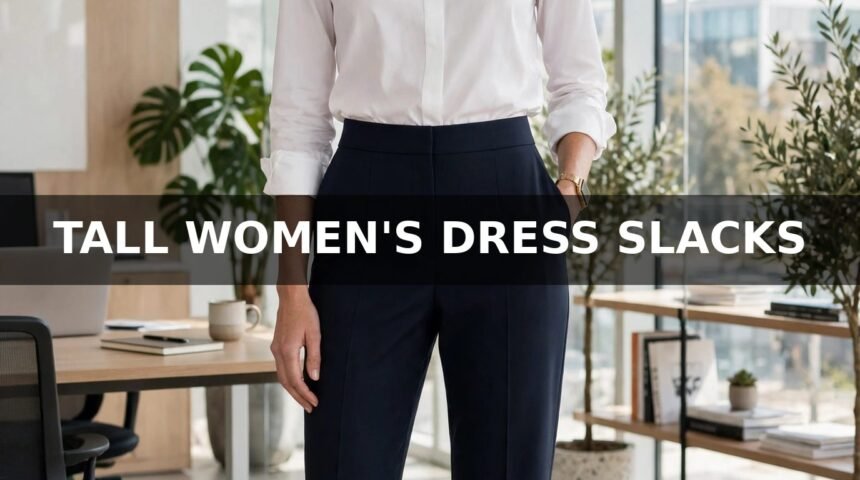
If you are tall, you already know the problem with dress slacks. A pair looks perfect on the hanger, the waist fits, the hips sit right, and then you put them on and the hem stops an inch or two above your ankle. Or the rise is too short, so the waistband digs in when you sit down. Or the knees land in the wrong place, which makes the whole leg look off even though nothing is obviously wrong. Tall women’s dress slacks are not just regular slacks made longer. They need a different pattern: a longer inseam, a longer rise, a knee placed lower on the leg, and enough room through the hip and thigh that the fabric hangs straight instead of pulling.
That is what this guide is for. It walks through how tall women’s dress slacks should fit, what inseam lengths are actually worth looking for, which styles tend to work best on a taller frame, which fabrics behave well in an office, how to measure yourself properly, how to style slacks for work and for smarter casual days, and what to check before you spend money on a pair. No brand hype, no magic fix — just the practical details that decide whether a pair of slacks becomes something you reach for every week or something that sits in the back of the wardrobe.
The short version, if you are in a hurry: look for an inseam of at least 34 inches, and preferably 35 to 37 inches if you are 5’10” or taller. Check the rise as well as the length, because a long leg with a short rise will never sit right. Choose a style that suits how you actually dress — straight leg for everyday work, wide leg when you want something more polished, tapered when you want a sharper line. And try them on with the shoes you will actually wear with them, because the hem that looks right in flats will look short in heels, and the hem that looks right in heels will pool in flats.
Why Regular Dress Slacks Rarely Fit Tall Women
Most dress slacks are cut for a woman of average height, which in pattern terms usually means someone around 5’4″ to 5’6″. The pattern is graded up and down from that middle size, but grading is not the same as redesigning. When a pattern is simply scaled up, the inseam gets longer, but the proportions do not always follow. The knee stays too high. The rise stays too short. The pocket placement shifts. The result is a pair of trousers that technically comes in your size and technically reaches your ankle, but still does not look or feel like it was made for your body.
The first problem is inseam length. A standard inseam of 30 or 31 inches is the default for most women’s dress slacks. For a woman who is 5’9″, that is usually too short for a full-length look. The hem ends above the ankle bone, which reads as cropped even when the trousers were sold as full length. You can sometimes get away with it in summer, with loafers and bare ankles, but in a work setting it looks like the trousers shrank. Tall ranges exist for exactly this reason, and the difference between a 31-inch inseam and a 35-inch inseam is not subtle. It changes the whole line of the leg.
The second problem is rise. Rise is the distance from the crotch seam to the top of the waistband, and it matters more than most shoppers realise. A tall woman often has a longer torso as well as longer legs, so a regular rise can sit too low. When the rise is too short, the waistband pulls down when you sit, the front creases, and you spend the day tugging the trousers back up. A mid-rise or high-rise cut usually works better, because it gives the waistband somewhere to sit without fighting your body. This is one of the reasons tall women’s dress slacks from a dedicated tall range often feel better even before you look at the length: the whole pattern, including the rise, has been adjusted.
The third problem is the knee. On a well-cut pair of slacks, the knee of the trouser lines up with your actual knee. On a pair cut for a shorter person, the knee of the trouser sits above yours. That sounds like a small detail, but it changes how the fabric falls. The leg can look bowed or twisted, the crease can sit in the wrong place, and a tapered leg can feel tight at the calf because the taper starts too high. If you have ever tried on slacks that felt fine at the waist and hips but somehow looked wrong from the knee down, the knee placement was probably the cause.
Then there is the waist-to-hip question. Tall women are not all built the same way, of course, but a common pattern is a longer distance between waist and hip, which means the hip curve of a regular pair can sit too high. The trousers pull across the front of the thigh or gape slightly at the back of the waist. None of this means you need a custom pair. It means you need a pair cut with tall proportions in mind, and you need to know what to check when you try them on.
The Difference a Tall Range Actually Makes
A proper tall range is not just the same trouser with extra inches added at the hem. The better ones adjust the rise, move the knee down, lengthen the back rise so the seat sits properly, and sometimes lengthen the pocket bags so your hands do not feel cramped. That is worth knowing when you are shopping, because it explains why two pairs with the same stated inseam can fit so differently. One was lengthened at the hem only. The other was recut for a tall frame.
It also explains why the cheapest fix — buying a bigger size to get more length — usually fails. Going up a size gives you a longer inseam on some cuts, but it also gives you a wider waist, wider hips, and a baggier seat. You end up with trousers that are long enough but loose everywhere else, and then you need a tailor anyway. Buying your true waist size in a tall length is almost always the better starting point.
What Inseam Length Should Tall Women Look For?
Inseam is the measurement from the crotch seam to the hem, taken along the inside of the leg. It is the single most useful number when you are shopping for tall women’s dress slacks online, because it tells you where the hem will actually fall. Waist size tells you about fit around the middle. Inseam tells you about length. Both matter, but inseam is the one that decides whether the trousers look full-length or accidentally cropped.
As a rough starting point, many tall women find that a 34-inch inseam is the minimum for a full-length look. At 5’9″ to 5’10”, a 34-inch inseam with flat shoes will usually reach the top of the foot. At 5’11” and above, or if you wear heels to work, 35 to 37 inches is a safer range. Some tall ranges go to 37 inches, and a few go beyond that. If you are 6’0″ or taller, do not settle for 34 inches just because it is the longest option on the page. Keep looking, or plan on a tailor adding length, which is only possible if the hem has enough allowance.
Height alone does not decide your inseam, though. Two women who are both 5’10” can need different inseams, because leg length varies. Some people carry their height in their legs, others in their torso. That is why measuring your own inseam matters more than going by height charts. A height chart is a starting guess. Your own measurement is the real number.
How Inseam Interacts With Shoes
The shoes you wear change the inseam you need, and this catches a lot of people out. A pair of slacks that looks perfect with ballet flats will look short with a two-inch heel, because the heel lifts your foot and changes where the hem falls relative to the floor. The usual advice is to choose your inseam for the shoes you wear most often with those slacks. If the slacks are for work and you wear heels most days, measure and try them on in heels. If you live in loafers, fit them in loafers.
The break matters here too. The break is the small fold or bend the fabric makes where it meets the shoe. A full break means the fabric pools slightly at the ankle. A half break means a gentle fold. No break means the hem just touches the top of the shoe. For dress slacks, most people prefer a slight break or no break — enough length to look polished, not so much that the fabric bunches. A tall woman aiming for a clean line usually wants the hem to reach the top of the shoe or just below the ankle bone, depending on the style. Wide-leg slacks need more length than tapered ones, because the wider hem has to fall cleanly over the shoe rather than catching on it.
Inseam Guide by Height
The table below is a rough guide, not a rule. Use it to narrow down your options, then confirm with your own measurement and a try-on with your usual shoes.
| Your height | A good starting inseam | Notes |
|---|---|---|
| 5’8″ to 5’9″ | 33 to 34 inches | Regular tall ranges usually cover this; check the rise too |
| 5’10” to 5’11” | 34 to 36 inches | 34 inches may look short with heels; 35 to 36 is safer |
| 6’0″ to 6’1″ | 36 to 37 inches | Look for ranges that go to 37 inches; check hem allowance |
| 6’2″ and above | 37 inches and up | Fewer ready-made options; tailoring or specialist tall retailers help |
Remember that these numbers assume a full-length style. If you deliberately want a cropped or ankle-length look, you will want a shorter inseam — but then you are choosing the crop on purpose, which is a different thing from trousers that are too short by accident.
How Tall Women’s Dress Slacks Should Fit
Fit is more than length. A pair of tall women’s dress slacks should fit well at the waist, hip, seat and thigh, and hang in a straight line from hip to hem. Here is what to check, area by area, when you try a pair on.
The Waist
The waistband should sit flat against your body without digging in or gaping. Put your finger between the waistband and your waist: you should be able to fit one finger comfortably, not two, and the band should not roll over when you sit. If the waistband gaps at the back, the rise may be wrong for you, or the cut may not suit your waist-to-hip difference. A small gap can sometimes be fixed by a tailor taking in the back waist, but a large gap usually means the wrong cut.
High-rise slacks sit at or just above the natural waist, which is the narrowest part of your torso. Mid-rise sits a little lower, around the hip bones. For tall women, high-rise and mid-rise both work, but high-rise often feels more secure, because it gives the longer torso more coverage and keeps the waistband in place when you move. Low-rise is harder to recommend for dress slacks on a tall frame, because the shorter rise fights the longer torso and the waistband tends to slide down.
The Hips and Seat
The fabric across the hips should lie smooth, without horizontal pull lines. Pull lines that run from the crotch outward usually mean the hips or thighs are too tight. Fabric that bags at the back of the thigh usually means the seat is too roomy or the back rise is too long. Turn sideways in the mirror and look at the line from waist to hem. It should be smooth and straight, not bowing out at the thigh and not collapsing inward below the seat.
Sit down in the trousers before you decide. A pair that looks fine standing up can pull badly when you sit, especially if the rise is short. The waistband should stay roughly where it was, the front should not crease into deep diagonal folds, and you should be able to sit comfortably without the fabric straining across the thighs.
The Leg
The leg should fall straight from the hip. On straight-leg slacks, the width at the knee and the width at the hem are roughly the same, which gives a clean, even line. On wide-leg slacks, the leg widens gradually from the hip, and the fabric should hang without swinging too far forward or back. On tapered slacks, the leg narrows toward the ankle, and the taper should start at or just below your actual knee, not above it.
Check the crease if the slacks have one. A front crease should run straight down the centre of the leg. If it veers off to one side, the leg may be twisted, or the knee placement may be off. That is a sign to try a different cut rather than a different size.
Styles of Tall Women’s Dress Slacks
There is no single best style. The right choice depends on your workplace, your body shape, and what you feel comfortable wearing. These are the main styles you will come across, and how each one tends to behave on a taller frame.
Straight-Leg Dress Slacks
Straight-leg slacks are the workhorse. The leg runs straight from hip to hem, which suits most body shapes and most offices. On a tall woman, a straight leg is often the easiest fit, because there is no dramatic taper or flare to get wrong. The line is simple, the hem sits cleanly over most shoes, and the style works with a tucked-in blouse, a blazer, or a fine-knit jumper. If you only buy one pair, make it a straight leg in a dark neutral colour. It will carry the most outfits.
One thing to watch with straight-leg slacks is the width. A very narrow straight leg can look like a cigarette trouser, which is fine if that is the look you want, but it can also emphasise the length of the leg in a way that feels stark. A moderate straight leg, with enough width to hang rather than cling, usually looks more balanced on a tall frame.
Wide-Leg Dress Slacks
Wide-leg slacks have had a long run in fashion, and they suit tall women particularly well. The extra width balances the length of the leg, and the fabric moves nicely when you walk. In a work setting, a wide leg in a structured fabric — a wool blend, a heavier crepe, a firm twill — looks polished and deliberate. In a lighter fabric, the same cut can look too casual for the office, so fabric choice matters as much as the cut.
The trick with wide-leg slacks is length. They need to be long enough to fall over the shoe, with the hem just skimming the floor at the back. Too short, and the wide leg looks boxy and unfinished. Too long, and you trip on them. This is the style where trying them on with your actual work shoes matters most. If you buy wide-leg slacks online, check the inseam carefully and be ready to have the hem adjusted. A good tailor can take up a wide leg cleanly, but letting one down is harder, so err on the side of too long rather than too short when you order.
Tapered and Slim Dress Slacks
Tapered slacks narrow from the knee to the ankle. They give a sharper, more modern line, and they work well with loafers, ankle boots, and pointed flats. On a tall frame, a tapered leg can look very smart, but it is also the style where knee placement matters most. If the taper starts too high, the calf feels squeezed and the ankle looks pinched. If the taper starts in the right place, the line is clean and the ankle opening sits neatly above the shoe.
Slim dress slacks are similar but narrower through the whole leg. They suit women who like a closer fit, but they are less forgiving. If you sit at a desk all day, make sure there is enough stretch in the fabric, or enough room through the thigh, that you are comfortable after a few hours. A slim leg with no give can feel fine for ten minutes in a fitting room and restrictive by lunchtime.
Pleated Dress Slacks
Pleats are folds of fabric at the front of the waistband that give extra room through the hip and thigh. They went out of fashion for a while and have come back, and they can be a good option for tall women who want more room without going up a size. A single pleat on each side gives a little extra ease. Double pleats give more. The key is that the pleats should lie flat when you are standing. If they gape open, the trousers are too tight through the hip, and the pleats are doing work they were not meant to do.
Pleated slacks tend to look more relaxed than flat-front slacks, so they suit smart-casual settings and workplaces that are not strictly formal. In a fine wool, a pleated pair can still look sharp enough for the office, especially with a tucked-in shirt and a belt.
High-Waisted and Paperbag Styles
High-waisted slacks sit at the natural waist and often come with a slightly wider leg. They are flattering on tall women because they lengthen the leg line even further and define the waist. A paperbag waist, where the fabric gathers above a belted waistband, is a more casual version of the same idea. It works well for smart-casual outfits but is usually too relaxed for a formal office.
If you try high-waisted slacks, check the back rise as well as the front. A high waist with a short back rise will pull when you sit, and the waistband will slide down at the back. The waistband should stay level all the way round, front and back, when you stand and when you sit.
Fabrics That Work for Tall Women’s Dress Slacks
Fabric decides how slacks drape, how they hold a crease, how they cope with a day at a desk, and how often you need to iron them. For dress slacks, the fabric needs to look smooth, hold its shape, and not wrinkle into a map of your working day by mid-afternoon.
Wool and Wool Blends
Wool is the classic dress-slack fabric, and for good reason. It drapes well, holds a crease, breathes, and recovers from wrinkles better than most fibres. A pure wool slack is a good investment if you wear dress slacks often, but it usually needs dry cleaning or careful washing. A wool blend — wool mixed with a small amount of polyester or elastane — is often more practical. The blend keeps most of wool’s drape, adds a little stretch for comfort, and is usually easier to care for. Look for a blend with a high wool content if you want the best drape, and a little elastane, often two to five percent, if you want movement.
For tall women, wool has another advantage: it hangs well over a long leg. A fabric that is too light can cling or fly around the calf. Wool has enough weight to fall straight, which is what you want in a full-length slack.
Crepe
Crepe is a fabric with a slightly textured, grainy surface. It drapes softly, does not show wrinkles much, and is comfortable to wear. Crepe slacks are a good choice for work, especially in warmer weather or in offices where you move around a lot. The drape is softer than wool, so crepe suits wide-leg and straight-leg styles well. It is less good at holding a sharp front crease, so if you want a very crisp, tailored look, wool is the better choice.
Polyester Blends and Technical Fabrics
Modern polyester blends have come a long way from the shiny, stiff fabrics of the past. A good polyester blend can look smooth, resist wrinkles, and wash easily. Many retailers use polyester blends for their tall ranges because the fabric is stable and easy to cut in long lengths. The downside is breathability: polyester does not breathe as well as wool or cotton, so it can feel warm in summer or in a heated office. If you run warm, check the fibre content and favour blends with viscose, wool, or cotton mixed in.
Some newer technical fabrics add stretch and wrinkle resistance, which is useful for travel or for long days. They are worth considering if you commute or fly often, but check the hand feel. A fabric that feels slick or plasticky in the shop will not feel better after a day of wear.
Cotton Twill and Stretch Cotton
Cotton twill is a sturdy, matte fabric that works well for smart-casual slacks. It is breathable and comfortable, but it wrinkles more easily than wool or crepe, and it can lose its shape over a long day. A cotton blend with a little elastane holds its shape better. Cotton slacks suit a smart-casual office or a day when you want to look polished without being formal. For a strictly formal workplace, wool or crepe usually looks sharper.
What to Avoid
Very thin, flimsy fabrics are a problem on a long leg, because they cling and show every line underneath. Very stiff fabrics are also a problem, because they stand away from the leg and look boxy. Shiny fabrics show wrinkles and draw attention to the fit, which is not what you want when the fit is already hard to get right. And be careful with fabrics that are mostly elastane or jersey: they can be comfortable, but they often read as leggings rather than dress slacks, which defeats the purpose in a work setting.
How to Measure Yourself for Tall Women’s Dress Slacks
Measuring yourself takes five minutes and saves a lot of returns. You need a soft measuring tape, a mirror, and the shoes you plan to wear with the slacks. If you can, ask someone else to take the measurements, because measuring your own inseam while standing is awkward and easy to get wrong.
Inseam
Stand straight in bare feet or in thin socks, with your feet slightly apart. Measure from the crotch seam of well-fitting trousers, or from the highest point of your inner thigh, straight down to the floor. Keep the tape straight and do not pull it tight. That number is your floor-length inseam. For dress slacks, you usually want the hem to sit just above the floor at the back when you are wearing your work shoes, so add the height of your usual heel to the barefoot measurement, or measure while wearing the shoes.
A simpler method, and often a more reliable one, is to measure a pair of trousers you already own that fit well in length. Lay them flat, measure from the crotch seam to the hem along the inside leg, and write that number down. That is the inseam that works for you in that style and with those shoes. Use it as your reference when you shop.
Waist
Measure around your natural waist, which is the narrowest part of your torso, usually just above the belly button. Keep the tape level and snug but not tight. Do not suck in. Breathe normally. If you are between sizes, note both and check the retailer’s size guide, because waist measurements vary between brands.
Hips
Measure around the fullest part of your hips, usually about eight inches below the natural waist. Keep the tape level and make sure it goes over the fullest point at the back as well as the front. This measurement matters because many women need a different size for waist and hips. If your hips measure a size larger than your waist, you may need to buy for the hips and have the waist taken in, or look for a curvy fit, which is cut with more room through the hip and thigh relative to the waist.
Rise
Rise is harder to measure on yourself, but you can get a useful number from trousers you own. Measure from the crotch seam to the top of the waistband at the front, and then at the back. Write both down. When you find a pair you like, compare its stated front rise to your own number. If the front rise on the product page is much shorter than yours, the trousers will probably sit too low.
A Note on Size Charts
Size charts are a guide, not a promise. Two retailers can use the same waist measurement for a different size label, and the same retailer can cut two styles differently. Always check the garment measurements on the product page, not just the generic size chart, and read the reviews if they mention length. Reviews from other tall women are especially useful: they will tell you whether the inseam runs long or short, whether the rise is generous, and whether the fabric holds up after washing.
Styling Tall Women’s Dress Slacks for Work
Dress slacks are versatile, but they look best when the rest of the outfit is in proportion. On a tall frame, the risk is not looking too tall — it is looking unbalanced, with a top that is too short or shoes that fight the hem. A few simple habits keep the outfit looking deliberate.
With a Blazer
A blazer and dress slacks is the classic work combination, and it suits tall women well. The key is the length of the blazer. A blazer that ends at the hip works with most slacks. A longer blazer that covers the seat can work with slim or tapered slacks, but it can swallow a wide-leg pair. Try the blazer buttoned and unbuttoned, and check the back in a mirror. The blazer should not pull across the bust or ride up when you sit.
For colour, you do not have to match the blazer and slacks exactly. A navy blazer with charcoal slacks, or a black blazer with dark grey slacks, looks polished without being a full suit. If you do want a suit, buy the jacket and slacks together, or at least from the same range, so the colour and fabric match.
With a Blouse or Shirt
A tucked-in blouse is the simplest way to wear dress slacks, and it shows off the waistline, which is flattering on a tall frame. The blouse needs to be long enough to stay tucked in when you sit and stand. This is a common frustration for tall women: a standard-length blouse pulls out of the waistband by mid-morning. Look for blouses in tall ranges, or for styles with a slightly longer body. A bodysuit-style top is another option, because it cannot untuck, but it is not for everyone.
If you prefer to wear your top untucked, choose one that ends at the hip bone or just below it. A top that ends mid-thigh will cut your leg line in half and make the slacks look shorter than they are. A top that ends at the waistband can work if it is fitted, but a boxy top worn loose over dress slacks usually looks untidy.
With Knitwear
A fine-knit jumper tucked into high-waisted slacks is a smart, comfortable work outfit, especially in cooler weather. The knit should be fine enough to tuck without bunching. A chunky knit is better worn over the slacks, ending at the hip, with the slacks providing the tailored contrast. Avoid a chunky knit tucked in: it adds bulk at the waist and fights the clean line of the slacks.
Shoes That Work With Dress Slacks
The shoe changes the whole outfit. Pointed-toe flats lengthen the leg line and work well with straight and tapered slacks. Loafers give a polished, slightly more relaxed feel and suit straight-leg and wide-leg styles. A low block heel adds height without making the hem a problem, and it is comfortable for a full day. A higher heel works with wide-leg slacks, because the extra length of the slack needs the extra height, but make sure the hem still clears the floor.
Ankle boots can work with tapered and straight-leg slacks, especially in cooler weather, but the boot should sit under the hem, not fight it. If the hem catches on the top of the boot, the line breaks. A boot with a slim shaft is usually easier than a chunky one. Trainers, even clean white ones, are a smart-casual choice rather than a work choice with dress slacks, unless your workplace is explicitly casual.
Smart-Casual Days
On a smart-casual day, the same slacks can be dressed down. A straight-leg pair in navy or charcoal works with a simple white T-shirt and loafers, or with a striped top and ballet flats. A wide-leg pair works with a fitted top and a denim jacket, or with a light knit and trainers. The slacks do the smart work; the top and shoes do the casual work. Keep one of them tailored and the other relaxed, and the outfit stays balanced.
Tailoring Tips for Tall Women’s Dress Slacks
Even a good tall range will not fit everyone perfectly. A tailor can fix most of the small problems, and for dress slacks, tailoring is often worth the money. A pair that fits well after a fifteen-minute alteration will get worn far more than a pair that almost fits.
What a Tailor Can Easily Fix
Hem length is the easiest fix. A tailor can take up a hem cleanly, keeping the original finish if possible. Taking up a wide leg is straightforward. Taking up a tapered leg needs a little more care, because the taper has to stay even, but a good tailor will manage it. Shortening is easy. Lengthening is harder, because it depends on how much fabric is left in the hem. When you buy slacks that are slightly too long, check the hem allowance before you buy: turn the hem up and see how much fabric is folded inside. If there is an inch or more, the tailor has something to work with. If there is almost nothing, the slacks cannot be lengthened.
Taking in the waist is also easy, especially at the back. A tailor can take in the centre back seam or add darts to remove a small gap. Taking in the waist by more than an inch or two is harder, because it changes the balance of the trousers. If the waist is more than a size too big, you probably bought the wrong size.
Tapering the leg from the knee down is possible, and it can turn a straight leg into a tapered one. It is a bigger job than a hem, so it costs more, but it is worth considering if you love the fabric and the fit everywhere else.
What a Tailor Cannot Easily Fix
A rise that is too short is very hard to fix. Lengthening the rise means rebuilding the crotch and the waistband, which is expensive and rarely looks right afterwards. If the rise is wrong, return the slacks and try a different cut.
A seat that is too tight is also hard to fix, because there is usually not enough fabric in the seam to let out. A seat that is too loose can be taken in, but a seat that pulls across the hips is a sign to go up a size or try a different style.
Knee placement is not something a tailor can move. If the knee of the trouser sits well above your knee, no alteration will fix it. That is a pattern problem, not a size problem, and the answer is a different pair.
When to Buy Tall and When to Buy Regular and Tailor
If you are 5’9″ or taller and you wear dress slacks often, buying from a tall range is usually the better choice. The pattern is right from the start, and you are only paying for a hem adjustment at most. Buying a regular length and having a tailor add length is rarely possible, because there is not enough fabric in the hem. Buying a regular length and accepting a shorter look is a choice, but then you are wearing cropped slacks, not full-length ones.
If you are between 5’7″ and 5’9″, you may find that some regular lengths work, especially in a straight leg with flats. Try both. The right answer is the one that fits your inseam and your rise, not the label on the range.
Common Mistakes When Buying Tall Women’s Dress Slacks
Buying a Bigger Size for Length
This is the most common mistake, and it almost never works. A bigger size gives you a wider waist and wider hips, not just a longer leg. You end up with slacks that are long enough but baggy everywhere else, and you still need a tailor. Buy your waist size in a tall length instead.
Ignoring the Rise
Length gets all the attention, but rise decides comfort. A pair with a generous inseam and a short rise will still pull when you sit, gap at the back, and slide down during the day. Check the rise on the product page, and try the slacks sitting down, not just standing up.
Trying Them On With the Wrong Shoes
A hem that looks right in the fitting room in bare feet will look different in your work shoes. Always try dress slacks on with the shoes you will wear most often with them, or at least with shoes of a similar heel height. If you are shopping online, measure your inseam in those shoes.
Choosing the Wrong Fabric for Your Day
A beautiful wool slack that needs dry cleaning after every wear is not practical if you wear slacks five days a week. A crepe or a washable blend might be a better everyday choice, with the wool saved for days when you want to look your sharpest. Think about your real week, not an ideal one, when you choose fabric.
Assuming All Tall Ranges Are the Same
Tall ranges vary. One retailer’s tall inseam is 34 inches. Another’s is 36. One adjusts the rise, another only adds length at the hem. Read the product details, check the garment measurements, and read reviews from other tall women. Do not assume that because one tall pair fit, the next one will too.
Skipping the Sit Test
Standing in front of a mirror tells you about the line of the leg. It tells you nothing about comfort. Sit down, cross your legs, walk to the other side of the room, and sit again. The slacks should feel the same after ten minutes as they did in the first minute. If the waistband digs in when you sit, or the fabric pulls across the thigh, the fit is not right.
Buying Checklist for Tall Women’s Dress Slacks
Use this checklist when you are shopping, whether online or in a shop. If a pair passes all of these, it is probably a good buy.
- Inseam: Is the inseam at least 34 inches, or 35 to 37 inches if you are 5’10” or taller, or if you wear heels? Does the stated inseam match your own measurement?
- Rise: Is the rise mid or high? Does the waistband stay in place when you sit?
- Waist: Does the waistband sit flat, without gaping at the back or digging in at the front?
- Hips and seat: Does the fabric lie smooth across the hips, without pull lines or bagging?
- Knee placement: Does the knee of the trouser line up with your knee? Does the taper, if there is one, start at or below the knee?
- Hem and break: Does the hem reach the top of your shoe, with a slight break or no break? Does a wide leg fall cleanly over the shoe?
- Fabric: Is the fabric right for how often you will wear the slacks and how you will clean them? Does it drape, or does it cling?
- Pockets: Do the pockets lie flat? Do they add bulk at the hip? On dress slacks, flat pockets that do not gape are usually the most flattering.
- Care: Can you wash the slacks at home, or do they need dry cleaning? Be honest about whether you will actually take them to the cleaner.
- Hem allowance: Is there enough fabric in the hem for a tailor to lengthen them if needed, or to let them down later?
- Shoes: Have you tried them on with the shoes you will actually wear with them?
- Comfort after ten minutes: Have you sat down in them, walked in them, and checked that they still feel comfortable?
If a pair fails on length alone, and everything else is right, it is still the wrong pair. Length is not a detail you can ignore on tall women’s dress slacks. It is the whole point.
FAQs
What inseam do tall women need for dress slacks?
Most tall women need an inseam of at least 34 inches for a full-length look. At 5’10” and above, or if you wear heels, 35 to 37 inches is a safer range. The exact number depends on your leg length rather than your height alone, so measure your own inseam and compare it with the garment measurement on the product page.
Where should dress slacks end on a tall woman?
For a full-length style, the hem should reach the top of the shoe, or just below the ankle bone, with a slight break or no break. Wide-leg slacks should fall over the shoe, with the hem just skimming the floor at the back. If the hem ends well above the ankle, the slacks are too short, even if they were sold as full length.
Are wide-leg slacks good for tall women?
Yes, wide-leg slacks often suit tall women very well. The extra width balances the length of the leg, and the fabric moves nicely when you walk. The key is getting the length right: wide-leg slacks need to be long enough to fall cleanly over the shoe. In a structured fabric, a wide leg looks polished enough for work. In a lighter fabric, it reads more casual.
Should tall women wear high-waisted dress slacks?
High-waisted slacks work well for many tall women, because they define the waist and lengthen the leg line. They also give a longer torso more coverage, which keeps the waistband in place. Check the back rise as well as the front, and make sure the waistband stays level when you sit. Mid-rise is also a good option if you prefer a slightly lower waist.
Can a tailor make regular slacks fit a tall woman?
A tailor can shorten a hem, take in a waist, and taper a leg, but a tailor cannot easily add length if there is not enough fabric in the hem, and cannot fix a rise that is too short or a knee that sits in the wrong place. If you are tall, it is usually better to start with a tall range, where the pattern is already right, and use a tailor for small adjustments.
What is the best fabric for tall women’s dress slacks?
Wool and wool blends drape well and hold a crease, which makes them a good choice for formal work. Crepe drapes softly, resists wrinkles, and suits wide-leg and straight-leg styles. Polyester blends are practical and easy to care for, but check breathability. Cotton twill is comfortable and breathable, but wrinkles more easily. The best fabric depends on how often you wear the slacks, how you clean them, and whether you run warm.
How do I stop dress slacks from looking too short?
Buy your true waist size in a tall length, not a bigger size in a regular length. Check the inseam before you buy, and try the slacks on with your usual work shoes. If you are between lengths, choose the longer one and have a tailor take up the hem. And check the rise: slacks that are too short in the rise can look short even when the inseam is right, because the whole trouser sits lower than it should.
Do tall women’s dress slacks need to be a specific style for work?
No. Straight-leg, wide-leg, tapered, and pleated slacks can all work for the office, as long as the fabric is smart and the fit is clean. Straight leg is the safest all-rounder. Wide leg looks polished in a structured fabric. Tapered looks sharp with loafers or pointed flats. Choose the style that suits your workplace and that you feel comfortable wearing all day.
Conclusion
Finding tall women’s dress slacks that actually fit is not about luck. It is about knowing your inseam, checking the rise as well as the length, and choosing a style and a fabric that suit your real working day. A 34-inch inseam is a good minimum for most tall women, and 35 to 37 inches is a safer bet if you are 5’10” or taller or you wear heels. A tall range that adjusts the rise and the knee placement, not just the hem, will fit better than a regular pair in a bigger size. And a pair that passes the sit test, the shoe test, and the mirror test is a pair you will actually wear.
Start with your measurements. Write down your inseam, your waist, and your hips, and keep them somewhere you can find them when you shop online. Use the checklist in this guide when you try a pair on, and do not settle for slacks that are almost long enough. Almost long enough is still too short, and you will notice it every time you look in the mirror. The right pair is out there — it just takes a little more checking to find it, and once you find it, you will know, because you will stop thinking about your trousers and get on with your day.
Read Also: Gap Women’s Breathe High Rise Bikini 3-Pack (2026 Guide)