

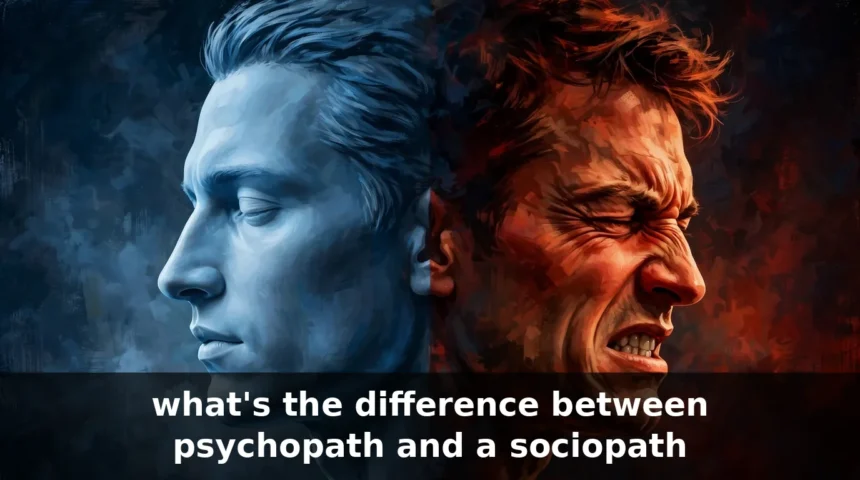
People use “psychopath” and “sociopath” as if they were the same word, usually to describe someone cold, selfish, or cruel. A cheating partner gets called a sociopath. A calm, calculating villain in a film gets called a psychopath. In everyday speech the two labels blur together, but in psychology they point to noticeably different patterns of behavior — different in how the person thinks, how they lose control (or don’t), and even in how researchers believe the condition develops in the first place.
Here is the short version. Psychopathy is generally linked to traits a person is born with: a shallow emotional life, very little fear, no real empathy, and a smooth, planned-out way of manipulating people. Sociopathy is generally linked to traits shaped by environment — a rough childhood, trauma, neglect, or chaotic surroundings — and it tends to look messier: impulsive, hot-tempered, erratic, and far less able to keep up a normal front. Neither term is an official diagnosis, which is a detail that matters, and we will get to it. First, let’s look at each pattern on its own terms.
What Is a Psychopath?
A psychopath is someone whose personality is organized around a striking lack of empathy and conscience, combined with a talent for appearing completely normal. That second part is what unsettles people. Psychopaths are often charming on the surface. They read a room quickly, say the right things, and can hold down jobs, relationships, and a respectable public image for years. The performance works because it is planned. Underneath it, though, the emotional machinery most of us rely on simply runs at a much lower volume.
Traits commonly associated with psychopathy include:
- Superficial charm and confidence — glib, engaging, and quick with an answer for everything.
- A grandiose sense of self-worth — a deep belief that they are smarter and more capable than everyone around them.
- Pathological lying and manipulation — dishonesty used calmly and deliberately, as a tool rather than a habit.
- A shallow emotional range — emotions like love, guilt, and remorse are imitated more than felt.
- Very low fear and anxiety — threats and consequences that would rattle most people barely register.
- Callousness — genuine indifference to the pain or rights of other people.
Researchers who study psychopathy often point to the brain. Studies using brain imaging have repeatedly found reduced activity in the amygdala — the region involved in fear and in recognizing distress in other people’s faces — among people who score high on psychopathy measures. That finding helps explain the classic picture: a person who can watch someone suffer without flinching, who does not learn from punishment the way others do, and who can lie in a high-stakes moment with a steady heart rate. Psychologist Robert Hare, whose Psychopathy Checklist (the PCL-R) became the standard research tool for measuring these traits, estimated that roughly 1 percent of the general population meets the threshold for psychopathy — while the share is far higher, often cited around 15 to 25 percent, inside prison populations.
The important thing to hold onto is control. A psychopath’s harmful behavior is usually calculated rather than impulsive. If they commit a crime, it is more likely to be planned. If they wreck a workplace, it is more likely to be through quiet manipulation over months than through a single explosive outburst.
What Is a Sociopath?
A sociopath shows a similar disregard for other people and for the rules, but the presentation is very different. Where the psychopath is composed, the sociopath is volatile. Sociopathic behavior is marked by impulsivity, irritability, and a short fuse. These are people who act first and deal with the wreckage later — if they deal with it at all.
Traits commonly associated with sociopathy include:
- Impulsiveness — decisions made on the spot, with little thought about consequences.
- Frequent anger and aggression — arguments, fights, and blowups that escalate fast.
- Erratic, unstable living — trouble holding a job, keeping housing, or maintaining routines.
- Difficulty sustaining relationships — though, unlike psychopaths, sociopaths may form real attachments to a small circle of people.
- A weak but present conscience — they may know an act is wrong in the abstract and do it anyway, or feel something afterward, without that feeling changing the behavior.
- Reckless disregard for safety — their own and everyone else’s.
Sociopathy is usually discussed as something made rather than born. The typical profile involves a childhood marked by abuse, neglect, extreme inconsistency, or violence — an environment where empathy was never properly modeled and survival mattered more than anyone else’s feelings. That background produces someone whose antisocial behavior is a reaction pattern, learned early and rehearsed often. Because of that, a sociopath’s behavior tends to erupt in the open. They are the ones who get fired after a screaming match, who pick the fight in public, who burn bridges they actually needed. Holding up a polished double life for years is usually beyond them, not because they are honest, but because they cannot sustain the discipline it requires.
Psychopath vs. Sociopath: The Key Differences Side by Side
Once the two profiles are clear, the contrasts line up neatly. The table below sums up the differences most often drawn by clinicians and researchers who still use these terms informally.
| Feature | Psychopath | Sociopath |
|---|---|---|
| Believed origin | Mostly genetic and neurological — born with it | Mostly environmental — shaped by upbringing and trauma |
| Emotional style | Cold, shallow, controlled | Volatile, reactive, prone to rage |
| Impulse control | Strong; behavior is planned and calculated | Weak; behavior is impulsive and erratic |
| Conscience | Essentially absent | Weak or underdeveloped, but not entirely missing |
| Relationships | Fake and instrumental — people are tools or targets | May bond with a select few; most relationships still unstable |
| Career and social front | Often successful at maintaining a normal, even impressive, public life | Usually struggles to hold jobs or keep up appearances |
| Typical harmful behavior | Premeditated, manipulative, low-profile | Spontaneous, confrontational, easy to spot |
One popular shorthand captures the difference in a single line: psychopaths are born, sociopaths are made. Like most one-liners, it oversimplifies — genes and environment interact in both cases, and serious researchers treat the line as a teaching shortcut rather than a law. But as a first approximation, it points in the right direction, and it explains why the two patterns look so different from the outside even though both involve a failure to care about other people.
Think of it this way. If someone methodically empties a company bank account over two years while smiling through every meeting, clinicians describing the case informally would reach for “psychopath.” If someone smashes up an office on their last day and has a police record full of bar fights and impulsive theft, the same clinicians would more likely say “sociopath.” Same disregard for others. Completely different temperature.
Why Neither Word Is an Official Diagnosis
Here is the part that surprises most people: if a psychiatrist sat down to diagnose either condition today, neither word would appear in the paperwork. The DSM-5, the manual used by clinicians in the United States, does not list psychopathy or sociopathy as diagnoses. The official diagnosis that covers this territory is antisocial personality disorder (ASPD).
ASPD describes a long-standing pattern, beginning by early adulthood and rooted in behavior visible since the mid-teens, of disregarding and violating the rights of others. Its listed features include repeated law-breaking, deceitfulness, impulsivity, irritability and aggressiveness, reckless disregard for safety, consistent irresponsibility, and a lack of remorse after harming others. A diagnosis requires the person to be at least 18, with evidence of conduct problems before age 15. Estimates of how common ASPD is vary by study; the DSM-5 places it somewhere in the range of roughly 0.2 to 3.3 percent of the population, and it is diagnosed considerably more often in men than in women.
So where do the older words fit? Most people who would informally be called sociopaths fall under the ASPD umbrella, because ASPD is defined mainly by behavior, and sociopathic behavior is exactly the kind of behavior the criteria describe. Psychopathy is narrower. It is treated as a specific, measurable personality configuration — assessed with tools like Hare’s PCL-R — and only a subset of people with ASPD score high on it. Researchers sometimes summarize it like this: most psychopaths meet the criteria for ASPD, but most people with ASPD are not psychopaths. The psychopathic group tends to show the deeper emotional deficits — the missing empathy and fear — on top of the antisocial behavior.
Common Myths That Muddy the Water
“They’re all violent criminals”
They are not. Violent offenders are the visible tip of a much larger pattern. Many people with strong psychopathic traits never commit a violent crime at all; some channel the same fearlessness, charm, and ruthlessness into business, politics, or other high-pressure arenas, which is why you will sometimes hear the phrase “corporate psychopath.” The traits are about how a person relates to others, not about a guarantee of violence.
“A psychopath is just someone who had a breakdown”
This one comes from confusing “psychopath” with “psychotic.” They are entirely different. Psychosis involves losing touch with reality — hallucinations, delusions, disorganized thinking — and is associated with conditions such as schizophrenia. A psychopath’s grip on reality is usually perfectly intact. That is precisely what makes the manipulation possible.
“You can spot one from a single conversation”
No, and this matters. Labeling an ex, a boss, or a family member a psychopath or sociopath based on bad behavior alone is not a diagnosis; it is an insult wearing a lab coat. These patterns are assessed by trained professionals using history, records, and structured evaluation over time. Plenty of people are selfish, dishonest, or cruel without meeting any clinical threshold, and flattening that distinction helps no one — least of all someone dealing with a genuinely difficult person, who needs practical help rather than a label.
Can Psychopaths or Sociopaths Change?
Honestly, the outlook is limited, and it is better to say so plainly. Antisocial personality disorder is considered one of the harder conditions in psychiatry to treat. There is no medication approved specifically for it, though medication is sometimes used for conditions that travel alongside it, such as depression, anxiety, or aggression. Talk therapy runs into an obvious obstacle: treatment depends on the patient caring about change, forming some trust with the therapist, and feeling genuine discomfort about the harm they cause — the very capacities that are impaired.
That said, “hard to treat” is not the same as “nothing ever changes.” Antisocial behavior in many people becomes less intense with age, particularly the impulsive, confrontational kind associated with sociopathy; researchers have long observed that rates of antisocial behavior decline as people move through their forties and beyond. Structured therapy focused on consequences and behavior, rather than on insight alone, shows modest results for some. For psychopathy, the emotional core appears more resistant, and professionals generally focus on managing behavior and risk rather than expecting a transformation of personality.
If someone in your life fits these patterns, the realistic takeaway is this: protect yourself first. Keep boundaries firm, avoid relying on promises of change that have no track record behind them, document problems at work rather than handling them informally, and involve professionals or authorities when safety is at stake. You cannot love, argue, or reason someone out of a personality structure — and it is not your job to try.
Frequently Asked Questions
What is the main difference between a psychopath and a sociopath?
The core difference is control and origin. Psychopathy is linked mainly to innate traits — shallow emotions, no real empathy or fear, and calculated, planned behavior. Sociopathy is linked mainly to environment and upbringing, and it shows up as impulsive, erratic, emotionally volatile behavior. In short: the psychopath plans, the sociopath erupts.
Which is more dangerous, a psychopath or a sociopath?
Neither label automatically means dangerous, and most people with these traits are not violent. Psychopaths are generally considered harder to identify and more capable of planned, large-scale harm because they can maintain a normal facade. Sociopaths are more likely to cause visible, impulsive harm in the moment. Risk depends on the individual and their history, not just the label.
Are psychopaths and sociopaths the same as antisocial personality disorder?
Not exactly. Antisocial personality disorder (ASPD) is the official clinical diagnosis, and it is defined by behavior. Sociopathy is an informal term that overlaps heavily with ASPD. Psychopathy is a narrower research concept involving specific personality traits, especially emotional shallowness and callousness; many people with ASPD do not qualify as psychopaths.
Can a psychopath feel love or empathy?
Research suggests people high in psychopathic traits can understand what others are feeling in an intellectual sense — they can read emotions well enough to use them — but they do not resonate with those feelings emotionally. That gap between understanding and feeling is exactly what makes manipulation possible, and it is why apologies from such a person can sound perfect while meaning very little.
Are psychopaths born or made?
Mostly born, according to the prevailing view — genetics and brain development play the leading role, which is why the traits tend to appear early and stay stable. Sociopaths, by contrast, are usually described as made, shaped by abusive, neglectful, or chaotic environments. In reality both nature and nurture are involved in every case; the distinction is about which influence dominates.
Can a sociopath or psychopath be cured?
There is no cure, and no medication is approved specifically for antisocial personality disorder. Some behavior improves with age, and structured therapy can help certain individuals manage impulses and consequences. Professionals usually aim for risk management and behavior change rather than a complete personality overhaul.
Conclusion
Psychopath and sociopath describe two different ways the same basic failure — a disregard for other people — can show up in a life. The psychopath is the colder, more controlled version: emotionally shallow, largely born rather than shaped, and capable of hiding in plain sight for years. The sociopath is the hotter, more chaotic version: impulsive, reactive, and usually traceable to a damaging environment. Neither word is an official diagnosis — that role belongs to antisocial personality disorder — but understanding the difference between the two patterns is genuinely useful, whether you are trying to make sense of a character in a novel, a case in the news, or a person whose behavior has been quietly costing you for years.
Read Also: women’s eyeglass frames